

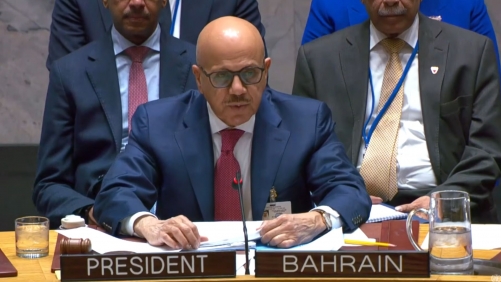
UN Resolution Blocked: Council Fails to Pass Bahrain-Led Maritime Security Resolution
The United Nations Security Council on Tuesday failed to adopt a draft resolution aimed at strengthening maritime security and ensuring freedom of navigation in the strategic Strait of Hormuz, after it was blocked by vetoes from Russia and China, with Colombia and Pakistan abstaining.
The Kingdom of Bahrain formally presented the resolution during its presidency of the Security Council in April 2026. The proposal was developed in close coordination with the member states of the Gulf Cooperation Council and Jordan.
The draft called for coordinated “defensive measures” to safeguard navigation in the Strait of Hormuz, a critical energy and trade corridor linking global markets through the Arabian Gulf and the Arabian Sea.
After the Vote
Dr. Abdullatif bin Rashid Al Zayani, Minister of Foreign Affairs, who is leading Bahrain’s presidency of the United Nations Security Council for April addressed the United Nations following the vote. “Bahrain, along with other GCC states and Jordan, expresses regret that the resolution presented today was not adopted,” he said. He added that the Council failed “to shoulder its responsibility regarding illegal conduct that requires urgent action without delay,” stressing that the draft intends to be a step toward a lasting solution to guarantee freedom of navigation in the Strait of Hormuz under international law.
The statement further called for full compliance with international legal obligations and referenced previous Security Council resolutions, including Resolution 2817, urging immediate enforcement.
Global Impact
The Gulf-led statement stressed that disruptions in the Strait of Hormuz could have far-reaching consequences for the global economy, including energy market instability, disruptions to global trade routes, impacts on food and medical supply chains, and increased risks to international shipping security.
It also highlighted the role of Gulf states as key global energy suppliers and stabilizers of international markets, noting their importance to both developed and developing economies.
Credibility of the Council
Dr. Al Zayani warned that the Council's failure to act decisively raises serious questions about its effectiveness in maintaining international peace and security. “The credibility of the Council is at stake today. It is not an abstract concept. It is measured by the ability to act decisively when circumstances require it,” he stated.
He further stressed that failing to adopt the resolution does not change realities on the ground, nor does it weaken existing international legal obligations or the right of states to defend their sovereignty under Article 51 of the UN Charter.
Related Posts