

Bahrain’s Billion-Pound Moment
TDT | Manama
Email: mail@newsofbahrain.com
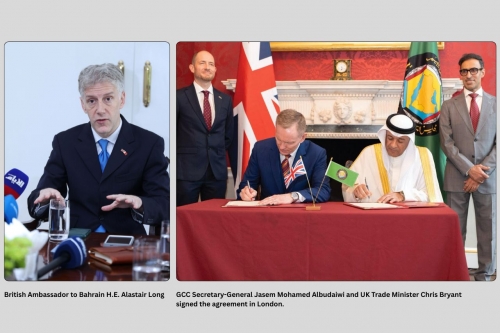
When British Ambassador to Bahrain H.E. Alastair Long sat down with journalists in Manama yesterday, the mood was quietly historic. The GCC–UK Free Trade Agreement, years in the making, had just been initialled at 11 Downing Street between UK Trade Minister Chris Bryant and GCC Secretary General Jasem Al Budaiwi. For Bahrain, the implications go well beyond tariff reductions.
The numbers alone tell a compelling story. UK–GCC bilateral trade currently stands at £53 billion, with two-way investment reaching $485 billion as of end2024. The agreement is projected to grow that trade by 20 percent, potentially adding £15.5 billion annually once fully in force.
“It is the first agreement the GCC has ever signed with a G7 nation,” Ambassador Long said. “And it is the most far-reaching agreement the GCC has ever signed, in that it encompasses so many future aspects, not just goods, but services, digital, clean energy, and innovation.”
The UK has liberalised 99 percent of all trade lines with the GCC, meaning Bahraini businesses and exporters will face dramatically lower barriers to the UK’s market of 70 million consumers. On the UK side, £360 million in annual duties to the GCC will lift immediately upon entry into force.
Why Bahrain Stands to Gain Most?
Of all six GCC members, Ambassador Long was direct about which country is best positioned to capitalise.
“The country that has the closest alignment with the UK in terms of its current industrial trajectory is Bahrain,” he said. “Bahrain is a much more service-oriented economy.
It has already got far greater diversification than some of the other Gulf markets, and it is looking, like the UK, into industries like financial services, education, and the knowledge economy.” Bahrain’s bilateral trade with the UK currently sits at £1.3 billion. The Ambassador was unambiguous about the target: “We’re looking to get it over two billion as soon as we can, and we really see this agreement as a huge opportunity to do that.”
New British investors have already begun arriving. “We’ve had some really exciting new tenants coming into Bahrain just within the last six months,” Long noted, adding that a further investor roadshow to the UK is planned for this summer.
Modern Deal for a Modern Economy
Ambassador Long was emphatic that this is not a conventional trade agreement. “There is a fourth word in this agreement. It is a modern free trade agreement,” he stressed. “This isn’t simply one that lifts duties at the point of entry. It looks way beyond that.”
The initialled text will now undergo a legal review before formal signature, a process of months rather than years. Full entry into force may follow within a year of signature, at which point the more immediate benefits—tariff reductions, streamlined customs, and new investment structures—will take effect rapidly.
“Deals like this mean we start to give people cheaper goods, a greater selection of goods, and a chance to get exports and investment moving,” Ambassador Long concluded. “This deal works for the affordability that families care about, and for the growth that economies need.”For Bahrain, a small, open, service-driven economy with deep ties to the UK and an eye firmly on the future, the timing could not be better.
Related Posts