

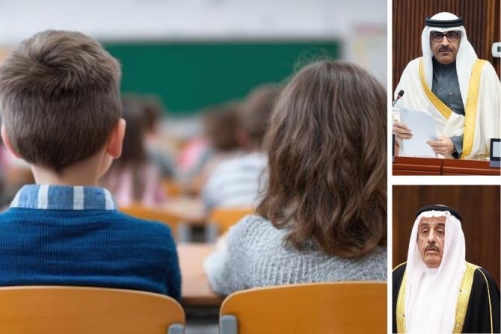
IQ and behaviour checks required for public school inclusion programme
TDT | Manama
Email: mail@newsofbahrain.com
An IQ score between 50 and 75, an age range of six to 15, and no history of severe behavioural or emotional problems are among the requirements the Education Ministry says it uses before a child is placed in its public school inclusion programme.
The details came in a written response to Shura Council member Abdullah Al Nuaimi, who asked how the ministry decides which pupils join mainstream classes, which remain in specialist classes, and what steps are taken to keep classrooms safe for everyone.
The ministry said pupils are placed either through full inclusion in mainstream classes or through partial inclusion via specialist classes, depending on academic assessment, medical reports and classroom behaviour.
Limit
It also confirmed a limit of two fully included pupils per classroom, saying the cap is meant to support teaching quality and keep classes orderly.
The ministry also provided figures on the size of the programmes.
It said mild intellectual disability and Down syndrome programmes operate in 67 schools, covering 382 students under the supervision of 125 teachers.
Autism
Autism programmes, it said, operate in 51 schools across 52 classes, covering 286 students in autism classes and 154 pupils fully included in mainstream classes under the supervision of 126 teachers.
Pupils with sensory and physical disabilities, it said, are included across public schools, numbering 264 students with physical disabilities, 321 with hearing disabilities and 93 with visual disabilities.
It referred to the constitution and the Education Law as the basis for its approach, saying the law requires educational opportunities for all and teaching that is adjusted for different needs.
Line
It also drew a line between the catch-all phrase ‘persons with special needs’ and the smaller group covered by the inclusion programme it was asked about.
The ministry said the wider term can include pupils with learning difficulties, speech and language disorders, behavioural problems, cancer, sickle-cell anaemia and gifted pupils. But it said its inclusion programme, in full or partial form, applies only to mild intellectual disability and Down syndrome, autism spectrum disorder, and sensory or physical disabilities.
For pupils with mild intellectual disability and Down syndrome, the ministry said placements can range from specialist classes to full placement in mainstream classes, depending on an assessment of ability.
Rehabilitation
Pupils with autism start in specialist classes and follow intensive rehabilitation programmes before any gradual move into mainstream lessons.
Pupils with hearing, visual or physical disabilities are placed in mainstream classes, with assistive devices, access support and other services where needed.
The ministry described two routes. Under partial inclusion, a student studies in a specialist class using a programme suited to their needs, backed by an individual learning plan.
Ability
The student can join mainstream classmates for lessons such as physical education, art and technology, and, depending on ability, for some lessons in main subjects including Arabic, mathematics, Islamic education, English and science.
It said students are also included in school events and competitions inside and outside Bahrain.
A move from partial to full inclusion can follow if a student shows academic and behavioural progress and can manage in a mainstream class.
Related Posts