

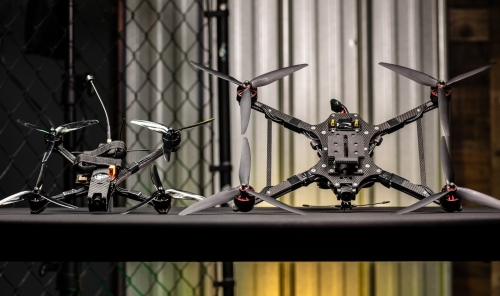
Ukraine Shapes U.S. Drone Strategy
The rapid evolution of drone warfare in Ukraine is increasingly influencing the U.S. defence industry, as American companies look to bring battlefield-tested technologies into domestic production.
One of those companies is Florida-based Powerus, a relatively new drone and autonomous-systems developer that is seeking partnerships with Ukrainian defence technology firms. Company executives say the goal is to adapt foreign-developed military technology for production in the United States and eventually supply the growing U.S. market.
The company’s strategy comes as the Pentagon places greater emphasis on inexpensive drones, autonomous systems and artificial intelligence. On September 30, U.S. Defense Secretary Pete Hegseth announced the creation of the Autonomous Warfare Command, a new military command focused on autonomous and robotic capabilities. Reuters reported that the move reflects the Pentagon’s effort to adapt to lessons from recent conflicts, particularly the war in Ukraine.
Ukraine Becomes a Testing Ground
The war in Ukraine has demonstrated how quickly drone technology can evolve on the battlefield. Ukrainian forces have used unmanned systems for reconnaissance, attack, logistics and air defence, while both sides have continuously adapted their technology in response to new threats.
A U.S. government report said Ukraine’s defence industry was producing tactical and long-range strike unmanned aircraft, along with counter-drone and electronic-warfare systems. The report also noted that Ukrainian manufacturers had expressed interest in exporting counter-drone systems to the United States and Gulf states.
Powerus sees this experience as an opportunity.
Company President Brett Velicovich, a former U.S. Army Special Operations intelligence analyst, said the company is talking with Ukrainian defence technology firms and is interested in adding capabilities including long-range attack drones. Reuters reported that Powerus wants to operate as a U.S. partner capable of bringing foreign military technology into American production.
From Battlefield Technology to U.S. Manufacturing
Powerus was incorporated in 2025 and is still an early-stage company. It reported first-quarter sales of about $1.2 million in 2026 after building its business through acquisitions and developing aerial and maritime autonomous systems.
The company has already introduced its Guardian interceptor drones, which Velicovich said were jointly developed with Ukrainians.
Powerus has also announced a U.S. Air Force contract potentially worth up to $90 million and other international business involving drone systems and infrastructure protection, according to Reuters.
The company's approach reflects a broader shift in the defence industry: rather than developing every system entirely from scratch, U.S. companies are increasingly looking to incorporate technologies developed in countries that have gained direct battlefield experience.
Pentagon Accelerates Drone Strategy
The U.S. military has been seeking to expand its drone capabilities as inexpensive unmanned systems become increasingly important in modern warfare.
In a July 2025 memorandum, the Pentagon described drones as one of the biggest battlefield innovations of the current era and called for expanding the American drone manufacturing base, accelerating procurement and giving military units greater access to low-cost unmanned systems.
The latest creation of the Autonomous Warfare Command signals another step in that direction, as the Pentagon seeks to combine drones, artificial intelligence and autonomous systems across the U.S. military.
Trump Family Investment Link
Powerus is also attracting attention because of its planned merger with Aureus Greenway Holdings, a Nasdaq-listed company that currently operates golf-course properties in Florida.
According to the companies’ regulatory filings, the proposed combination is expected to be completed in early October, subject to remaining closing conditions. The combined company is expected to operate under the Powerus name and continue trading on Nasdaq under the ticker PUSA.
Donald Trump Jr. and Eric Trump have an indirect financial connection to Aureus through American Ventures. Reuters reported that representatives for the brothers have described them as passive investors with no operational role in Powerus.
The investment connection comes as the Trump brothers expand their interests in the drone sector, including investments linked to Israeli drone maker XTEND and other unmanned-systems companies.
A Fast-Changing Defence Market
Powerus is entering a market where technology can become outdated rapidly. Ukraine’s experience shows that advances in drones are quickly followed by countermeasures, forcing manufacturers to continually develop faster, cheaper and more adaptable systems.
Recent Ukrainian battlefield developments illustrate that challenge. Reuters reported in September that Russia’s growing use of faster, jet-powered drones has forced Ukraine to develop new interceptor technologies, including AI-assisted systems and low-cost guided solutions.
For companies such as Powerus, the emerging market is therefore not simply about producing more drones. It is about rapidly transferring battlefield innovations into scalable American manufacturing while keeping pace with an evolving technological race.
Related Posts