

Global air cargo demand drops in March
Global air cargo demand declined in March 2026, as disruptions linked to conflict in the Middle East significantly impacted key logistics hubs, according to the International Air Transport Association.
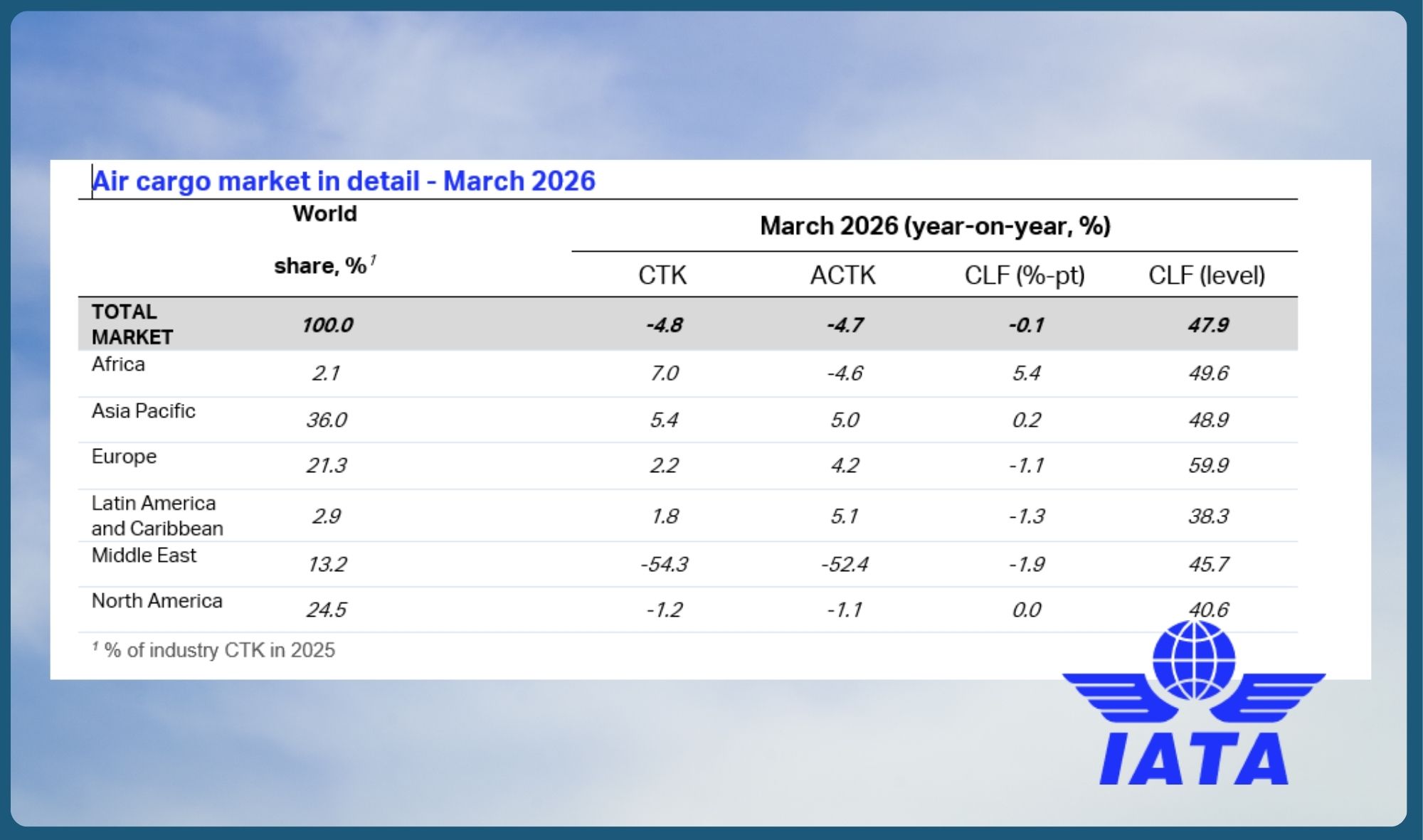
Data released by IATA showed total cargo demand, measured in cargo tonne-kilometres (CTK), fell by 4.8% compared to March 2025, while international cargo operations dropped by 5.5%. Capacity also declined by 4.7% year-on-year, with international capacity down 6.8%.
Willie Walsh said the downturn was largely driven by severe disruptions at major Gulf transit hubs amid ongoing regional conflict, combined with the seasonal slowdown following the Lunar New Year period.
Despite the decline, Walsh noted that underlying demand remains relatively strong, supported by positive global trade and economic outlooks from organisations such as the World Trade Organization and the International Monetary Fund.
Rising costs and global pressures
The industry is also facing mounting cost pressures, particularly from fuel. Jet fuel prices surged by more than 100% year-on-year in March, alongside sharp increases in crude oil prices and refining margins—factors that are expected to test airline resilience in the coming months.
At the same time, global industrial production rose by 3.1% year-on-year in February, marking continued expansion, while global goods trade increased by 8%. Manufacturing sentiment remained in growth territory, with key indicators pointing to stable conditions for cargo demand.
Regional performance highlights stark contrasts
Performance varied significantly across regions. Airlines in the Asia-Pacific region posted a 5.4% increase in cargo demand, supported by strong trade activity, while European carriers saw a 2.2% rise.
African airlines recorded the strongest growth at 7%, followed by Latin American and Caribbean carriers at 1.8%.
In contrast, North American carriers experienced a slight decline of 1.2%.
The most significant downturn was seen among Middle Eastern carriers, where demand plunged by 54.3% and capacity dropped by over 52%, reflecting the impact of airspace disruptions and reduced operations in the region.
Trade routes shift amid disruptions
Cargo flows across major global trade lanes showed diverging trends. Routes between Africa and Asia led growth, followed by Asia-Europe corridors, while intra-Asia trade remained resilient.
However, routes linked to the Gulf region were heavily affected by ongoing instability, forcing supply chains to adapt to changing conditions.
IATA said air cargo networks continue to play a crucial role in maintaining global supply chains, offering flexibility as industries respond to geopolitical tensions, shifting trade patterns, and operational challenges.
.
Related Posts