

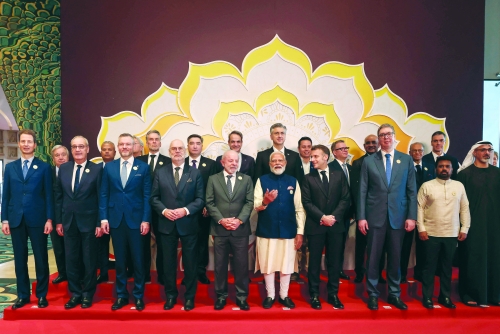
Global summit calls for ‘secure, trustworthy and robust AI’
AFP | New Delhi
Email : editor@newsofbahrain.com
Dozens of nations including the United States and China called for “secure, trustworthy and robust” artificial intelligence, in a summit declaration on Saturday criticised for being too generic to protect the public.
The statement signed by 86 countries did not include concrete commitments to regulate the fast-developing technology, instead highlighting several voluntary, non-binding initiatives.
“AI’s promise is best realised only when its benefits are shared by humanity,” said the statement, released after the five-day AI Impact Summit.
It called the advent of generative AI “an inflection point in the trajectory of technological evolution”.
“Advancing secure, trustworthy and robust AI is foundational to building trust and maximising societal and economic benefits,” it said.
The summit -- attended by tens of thousands including top tech CEOs -- was the fourth annual global meeting to discuss the promises and pitfalls of AI, and the first hosted by a developing country.
Hot topics discussed included AI’s potential societal benefits, such as drug discovery and translation tools, but also the threat of job losses, online abuse and the heavy power consumption of data centres.
Analysts had said earlier that the summit’s broad focus, and vague promises made at the previous meetings in France, South Korea and Britain, would make strong pledges or immediate action unlikely.
US signs on
The United States, home to industry-leading companies such as Google and ChatGPT maker OpenAI, did not sign last year’s summit statement, warning that regulation could be a drag on innovation.
“We totally reject global governance of AI,” US delegation head Michael Kratsios said at the summit on Friday.
The United States signed a bilateral declaration on AI with India on Friday, pledging to “pursue a global approach to AI that is unapologetically friendly to entrepreneurship and innovation”.
But it also put its name to the main statement, the release of which was originally expected on Friday but was delayed by one day to maximise the number of signatories, India’s government said.
Amba Kak, co-executive director of the AI Now Institute, criticised the lack of a meaningful declaration, saying it was just “another round of generic voluntary promises”.
“The fact that this declaration drew such wide endorsement, especially from the US, which held out in Paris, tells you what kind of agenda it is: one that is AI-industry approved, not one that meaningfully protects the public,” she told AFP.
Yesterday’s summit declaration struck a cautious tone on AI safety risks, from misinformation and surveillance to fears of the creation of devastating new pathogens.
“Deepening our understanding of the potential security aspects remains important,” it said.
“We recognize the importance of security in AI systems, industry-led voluntary measures, and the adoption of technical solutions, and appropriate policy frameworks that enable innovation.”
On jobs, it emphasised reskilling initiatives to “support participants in preparation for a future AI driven economy”. And “we underscore the importance of developing energy-efficient AI systems” given the technology’s growing demands on natural resources, it said.
The next AI summit will take place in Geneva in 2027. In the meantime, a UN panel on AI will start work towards “science-led governance”, the global body’s chief Antonio Guterres said Friday.
Related Posts