

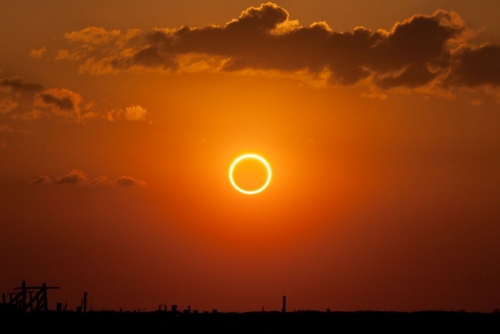
“Ring of Fire” Eclipse Marks First Solar Phenomenon of 2026
Email: online@newsofbahrain.com
The first solar eclipse of 2026 is expected on Tuesday, 17 February, when the Moon passes directly between Earth and the Sun but does not fully block the solar disk. This alignment produces an annular eclipse popularly known as a “Ring of Fire” because a glowing ring of sunlight remains visible around the Moon’s silhouette.
Unlike total eclipses where the Sun is completely obscured, an annular eclipse occurs because the Moon is slightly farther from Earth in its orbit, making it appear smaller and unable to cover the Sun fully. At peak coverage, scientists estimate the Moon will block close to 96% of the Sun’s centre, creating the striking ring effect.
The narrow path where the full annular phase is visible lies mainly over western Antarctica and parts of the Southern Ocean, making direct viewing extremely limited to those in or near those remote regions. Researchers at polar stations such as Concordia and Mirny could witness the full ring, while the general public will largely miss it.
People outside that path including in southern Africa, southern South America and certain ocean areas may see a partial eclipse, where the Sun appears partially covered by the Moon. However, in most of the Northern Hemisphere, including India and much of Asia, the eclipse will not be visible at all due to the Sun’s position below the horizon during the event.
During its brief peak, the annular phase is expected to last about 2 minutes and 20 seconds, depending on where it is observed along the eclipse path.
Astronomers and space agencies are urging skywatchers around the world to use certified solar viewing glasses or indirect viewing methods whenever observing any part of the eclipse, as looking directly at the Sun can cause serious eye damage even during an eclipse.
Related Posts