

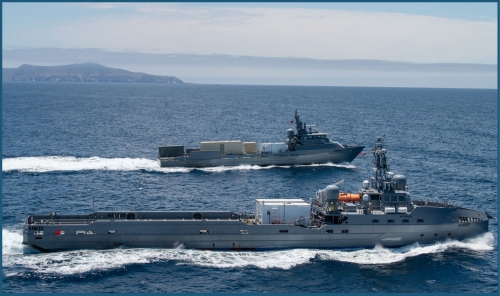
U.S. Navy Expands Fleet with Autonomous Vessels
After developing several prototypes, the U.S. Navy is preparing to deploy two medium-sized uncrewed surface vessels later this year. One of the vessels is also planned to be integrated with an aircraft carrier strike group in 2026.
Speaking at a conference in Washington last Wednesday, Garret Miller, who leads the development of these uncrewed vessels, said the Sea Hunter and Seahawk models will officially enter service with the U.S. Navy. His remarks were reported by the defence website Breaking Defense.
Miller said one of the two vessels will be deployed with a carrier strike group in 2026, though he did not specify which vessel or which carrier group. He added that the Navy plans to establish three early command teams for uncrewed maritime vehicles next week, as part of its broader move into autonomous systems.
According to Miller, the U.S. Navy aims to have operational squadrons of uncrewed maritime vehicles in every fleet. By 2027, the Navy is expected to have 11 medium-sized uncrewed vessels, with the number rising to more than 30 by 2030.
Both Sea Hunter and Seahawk were built by U.S.-based defence company Leidos and have been used as prototype platforms during Navy training exercises.
Sea Hunter was originally developed under the supervision of the Defense Advanced Research Projects Agency (DARPA) as an unmanned platform designed to detect and track submarines. Based on lessons learned from Sea Hunter, the U.S. Navy awarded Leidos a contract in 2017 to build Seahawk, which was delivered into service in 2021.
Conrad Chun, Vice President of Communications at Leidos, told Breaking Defense that the company is committed to providing advanced and reliable uncrewed vessel capabilities to the U.S. Navy, supported by years of testing and real-world deployments.
Related Posts