

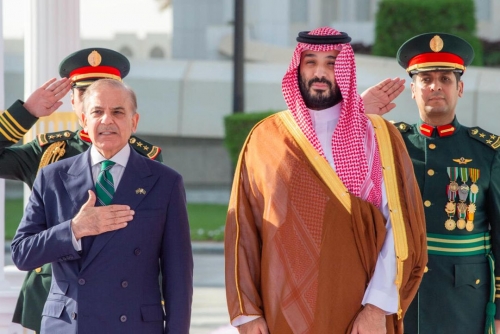
Pakistan and Saudi Arabia Sign Surprise Mutual Defence Pact Amid Regional Tensions
TDT | Doha
Email: mail@newsofbahrain.com
Pakistan and Saudi Arabia have signed a new mutual defence agreement this month, surprising observers and coming just days after Israeli airstrikes targeted a Hamas compound in Qatar. The pact arrives amid a volatile regional landscape, including Iranian and Israeli strikes on Doha, ongoing uncertainty over Tehran’s nuclear ambitions, and clashes between India and Pakistan in May.
“Even those accustomed to dramatic developments in the Middle East and South Asia were caught off guard by the announcement,” said Joshua White of the Brookings Institution.
While the agreement builds on decades of military cooperation between the two nations, details on its scope—particularly any nuclear dimensions—remain unclear.
Historical Ties
“The pact formalises and deepens decades of Saudi-Pakistani security and defence cooperation, building on a landmark 1982 protocol agreement,” White noted, which previously saw significant deployments of Pakistani troops to Saudi Arabia.
“There are many Saudi military personnel trained by Pakistan, and Pakistani officers are seconded within the Saudi Ministry of Defence,” added Camille Lons, a Gulf expert at the European Council on Foreign Relations.
According to Lons, the pact likely followed lengthy negotiations. “We must be cautious in linking it directly to recent events, though it could be seen as a response to growing Israeli influence in the region and Saudi doubts about American security guarantees,” she told AFP.
Syed Ali Zia Jaffery of the University of Lahore’s Center for Security, Strategy and Policy Research said the pact allows Pakistan to showcase its growing role in Middle Eastern security, while Saudi Arabia seeks to diversify its sources of protection beyond the United States.
Nuclear Questions Remain
Pakistan is estimated to possess around 170 nuclear warheads, according to the Bulletin of the Atomic Scientists, but how nuclear weapons might factor into the pact is ambiguous. No official statements have confirmed the creation of a nuclear umbrella—a rarity currently held only by the US for Europe and Russia for Belarus.
Several sources suggest nuclear capabilities may be included. A retired Saudi general told AFP anonymously that the treaty covers “conventional and non-conventional means,” adding, “We made it very clear that it includes Pakistani nuclear weapons.” Saudi analyst Ali Shihabi also stated that “nuclear is an integral part of this agreement.”
However, some experts urge caution. “Pakistan does not have a nuclear umbrella, and there is no evidence it plans to provide one to Saudi Arabia,” said Jaffery, emphasizing that Pakistan’s nuclear posture remains primarily India-centric. Bruno Tertrais of the Foundation for Strategic Research in Paris noted that any ambiguity may be intentional, forming part of a strategic deterrence strategy.
Regional Implications and India
Saudi Arabia maintains strong relations with India, Pakistan’s main rival, and counts as a major petroleum supplier to the country. Lons suggested that Riyadh would likely avoid escalation between Pakistan and India, pursuing a policy of multi-alignment.
The pact follows an intense four-day conflict between Pakistan and India earlier this year—the worst crisis between the two countries in decades. “Riyadh’s instinct would be to stay passive, preserving trade ties with India while honouring its security obligations to Pakistan,” said White.
As regional tensions continue, the full impact of the Saudi-Pakistani defence pact remains to be seen.
Related Posts