

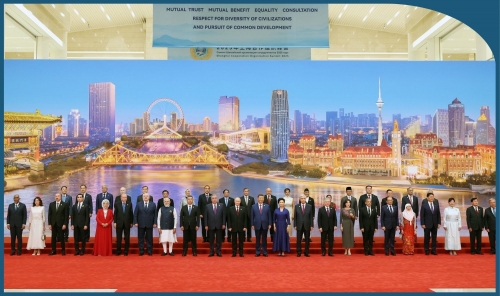
SCO Summit Brings Russia, India, China Together
Today, northern China hosted a major meeting of the Shanghai Cooperation Organization (SCO) in the port city of Tianjin. The summit brought together Russian President Vladimir Putin, Indian Prime Minister Narendra Modi, and leaders from eight other nations, highlighting growing regional cooperation amid global trade and security challenges.
The SCO, now a 10-member alliance, has expanded since its founding in 2001. Its full members are Russia, Belarus, China, India, Iran, Kazakhstan, Kyrgyzstan, Pakistan, Tajikistan, and Uzbekistan. Initially formed to counter U.S. influence in Central Asia, the group has grown with India and Pakistan joining in 2017, Iran in 2023, and Belarus in 2024.
While some members, like Iran and Belarus, are openly critical of the West, others—including India, China, and Russia—maintain more complex relationships due to trade tensions and the war in Ukraine. Today’s summit provided a platform for discussions on regional security, trade, and cooperation.
China’s Low-Risk, High-Profile Approach
Beijing has given few indications of specific outcomes it expects from the summit, consistent with its secretive diplomatic style. The official Xinhua News Agency called the gathering the “largest-ever SCO summit in history” and said it would chart “the blueprint for the bloc’s next decade of development.”
In addition to full members, about a dozen other countries joined as SCO dialogue partners or guests, including Egypt, Nepal, and several Southeast Asian nations. Xinhua highlighted the SCO’s guiding “Shanghai Spirit,” emphasizing mutual trust, equality, respect for diverse civilizations, and common development.
Observers note that China is eager to showcase the SCO’s economic benefits, citing growing trade and rail freight between China and other members, dialogue partners, and observer states. Key documents were also signed, including a notice marking the 80th anniversary of the end of World War II, which China will celebrate with a major military parade in Beijing on September 3.
Strategic Significance and Xi Jinping’s Vision
Experts say the summit allows China to project its vision of a multipolar world. University of Chicago political scientist Dali Yang noted that the SCO is one of China’s most prominent regional organizations, reflecting Beijing’s focus on maintaining international relationships even if the group has not solved major global challenges.
The summit comes just days before China’s massive military parade marking the 80th anniversary of Japan’s surrender in World War II, attended by Xi and other leaders, including North Korea’s Kim Jong Un. Analysts suggest that presiding over the gathering allows Xi to gain favorable publicity and strengthen his image as a leader in a new global order.
From Regional Bloc to Influential Alliance
China has traditionally dominated the SCO economically, while Russia has used it to maintain influence in Central Asia. Both countries also use the group for limited military cooperation, including joint drills. Newer members like India, Pakistan, Iran, and Belarus aim to share in the SCO’s growing influence, though the benefits of membership vary.
India’s Role Highlights Shifting Dynamics
India, historically neutral, has strengthened ties with Russia through oil imports and sought to improve relations with China. India’s participation challenges the dominance of Russia and China within the SCO, as New Delhi is unlikely to support Russia in Ukraine or China on territorial claims.
Two-day summit underscored the SCO’s evolving role in regional and global affairs, showcasing both economic cooperation and China’s efforts to promote a multipolar world order.
Related Posts