

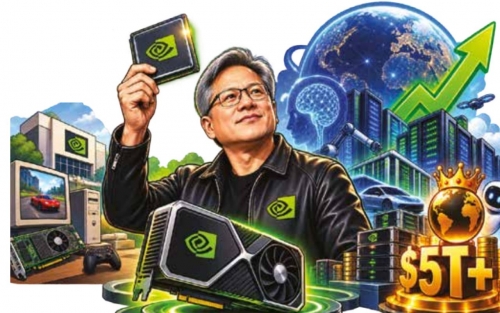
915,000% and Counting: Inside Nvidia’s Rise to $5 Trillion
How a graphics card maker became the backbone of the global AI boom
TDT | Manama
Email: mail@newsofbahrain.com
When Nvidia went public on January 22, 1999, it was a modest graphics chip company worth just $562.8 million, offering shares at $12 apiece. Today, Nvidia is the most valuable company on the planet, with a market capitalization north of $5.3 trillion — a staggering increase of roughly 915,000% since its IPO.
To put that in perspective: a $1,000 investment in Nvidia at its IPO, held and adjusted for the company's six stock splits since 1999, would be worth nearly $8.9 million today — a return of more than 889,000%, not including dividends.
How Nvidia got here
Nvidia's early years were built on gaming. Through the 2000s, its GPUs (graphics processing units) became the standard for rendering PC games, competing fiercely with rivals until it emerged as the dominant player in graphics hardware.
The real transformation came later. Nvidia's GPUs turned out to be exceptionally good at something far beyond gaming: running the massive parallel calculations needed to train artificial intelligence models. As cloud computing and cryptocurrency mining first drove demand for that computing power, then the generative AI boom — kicked off by tools like ChatGPT in late 2022 — sent demand into overdrive.
Nvidia's chips became the essential infrastructure of the AI era. The company's most recent fiscal year saw revenue top $215 billion, up 65% year-over-year, and representing more than a 136,000% increase compared to its fiscal 1999 revenue of $158 million. Today, an estimated 90% of that revenue comes from Nvidia's data-center business alone.
Securing the next decade of growth
That demand shows no sign of slowing — and Nvidia is moving to make sure supply doesn't fall behind. On August 11, Nvidia locked in a $500 billion financing alliance with major Wall Street firms, one of the largest infrastructure financing deals in tech history. The funding is earmarked to support the next wave of AI data-center construction — the physical backbone needed to train and run increasingly powerful AI systems.
The scale of the deal underlines a simple reality: even as Nvidia's chips power a global AI boom, compute demand continues to outpace supply. Data centers require enormous capital to build — from the chips themselves to power infrastructure, cooling systems and networking — and Nvidia's financing move signals confidence that demand for AI infrastructure will keep growing for years to come.
What it means going forward
Nvidia's journey from a $562 million gaming-chip startup to a $5 trillion-plus AI powerhouse is one of the most dramatic corporate transformations in market history. With its latest financing alliance, the company isn't just riding the AI wave — it's actively investing to make sure the infrastructure exists to sustain it for years to come.
Related Posts