

Cash rewards proposed for recycling
TDT | Manama
Email: mail@newsofbahrain.com
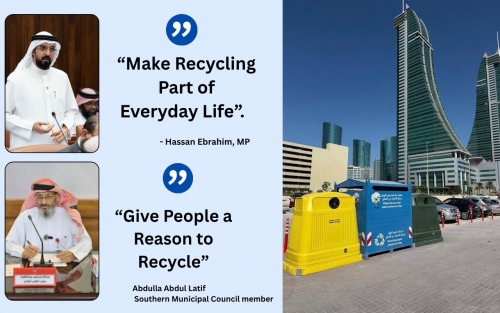
People need a reason to recycle, not simply another bin, Southern Municipal Council Chairman Abdulla Abdul Latif has said as he called for cash rewards and easier collection.
A proposal has already been submitted for a German-style bottle return scheme, under which people would get money back when they hand in empty bottles.
‘People should get something back when they recycle,’ Abdul Latif said.
MP Hassan Ebrahim told The Daily Tribune that Bahrain also needed to make recycling easier to reach and worth the effort.
‘Our strategy therefore needs to move from simply telling people to recycle towards making recycling easy, convenient and rewarding,’ he said.
Abdul Latif said many recycling bins had small, awkward openings that forced people to push waste through one item at a time.
For someone carrying a large amount of recyclable material, he said, that could mean standing at the bin for a long time feeding bottles and other items through separately.
‘You bring a bag full of bottles and then you are expected to open it and put every bottle in separately,’ Mr Abdul Latif told The Daily Tribune. ‘Why make things hard for people? Give them an open container where they can put the recyclable material in easily.’
Bahrain already has 300 recycling centres across all four governorates.
The Ministry of Municipalities Affairs and Agriculture said in December 2025 that the 300 centres had been placed across the country, with separate containers for paper and cardboard, plastic, glass and metals.
From January through October 2025, they collected 279 tonnes of recyclable material.
Paper and cardboard made up 209 tonnes, while plastic and glass each came to 28 tonnes and metals to 14 tonnes.
Abdul Latif said the problem now was getting people to use the centres regularly.
He said people were less likely to recycle when doing so took extra effort and offered them nothing in return.
A local supermarket had previously tested a reward scheme for recycling, he said.
‘The experiment was tried for a period and the results were very good,’ he said. ‘The municipality benefits and the citizen benefits.’
Ebrahim called for home or neighbourhood collection so families could separate recyclable waste without having to search for a recycling point.
Reverse-vending machines could also be placed in supermarkets, malls, universities and sports grounds, allowing people to return bottles and cans for points, discounts or another reward.
Like Abdul Latif, Ebrahim said Bahrain should study a deposit-return scheme for drinks containers, with people getting back a small sum when they return an empty bottle or can.
He also said recycling should be taught from an early age, with pupils introduced at school to why it matters and how it should become part of everyday life.
‘These are useful projects and the government has to support them,’ he said. ‘We need the ministries concerned to help such ideas grow and become part of how we deal with waste.’
He said recycling would work better when bins were easy to use, collection was closer to homes and bottles, cans and other useful material had some value instead of being thrown into the rubbish.
Related Posts