

Where Art Becomes Thought, Not Image
TDT | Manama
Email: mail@newsofbahrain.com
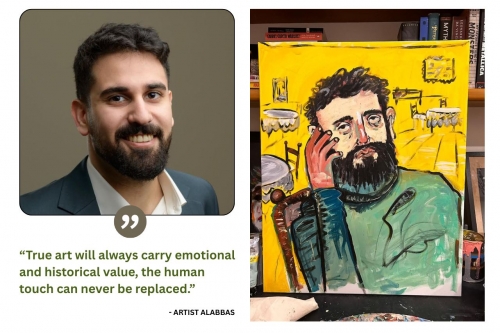
“Many people stand in front of my work and see a completely different story than the one I intended and I actually like that,” says 26-year-old Bahraini artist Khalid AlAbbas.
For AlAbbas, art is not about delivering clear answers. Instead, it is about creating a moment of pause. His work invites viewers to slow down, reflect, and engage with emotions that are often left unspoken.
“I like to isolate my character from their society and the world,” he says. “It creates a state of solitude and reflection.”
That sense of solitude is a recurring element in his work. Yet the loneliness he portrays is not necessarily negative. Rather, it is a space for growth and self-examination. “Loneliness and emptiness are not necessarily a bad thing,” he explains. “They are the moments in which a person reflects and grows out of what’s behind and past.”
His exploration of the human condition also extends to addiction, a subject he approaches as a deeply personal struggle rather than a public spectacle. “It’s something unique from person to another,” he says, describing it as an experience many people carry privately.
More recently, AlAbbas has become fascinated by the concept of time. Unlike other themes, time presents a challenge that cannot be directly seen. “Many of us forget how quickly time goes by,” he says. “It is the most precious thing we have.”
The artist is equally thoughtful about the changing landscape of contemporary art. While social media offers artists greater visibility, he believes it can also make meaningful work harder to discover. “Some really good artists go unseen due to algorithms,” he says, pointing to the growing pressure to prioritize engagement.
Still, he believes artists can navigate these challenges without compromising their values. “Chasing engagement does not mean losing your artistic morals,” he says. “It’s a challenge to overcome.”
The rise of artificial intelligence has also sparked debate across the creative world, but AlAbbas remains confident in the value of human expression. While he sees AI as a useful tool, he does not view it as a replacement for artists.
Despite his success, AlAbbas rejects the idea that art is driven primarily by talent. In fact, when asked what question he wishes more people would ask him, his answer is simple: Is talent necessary to become an artist?
“Many people consider art a talent which, if you lack, you can never be an artist,” he says. “My answer would be no.”
Related Posts