

Residents Urged to Report Mosquito Breeding Hotspots
TDT | Manama
Email: mail@newsofbahrain.com
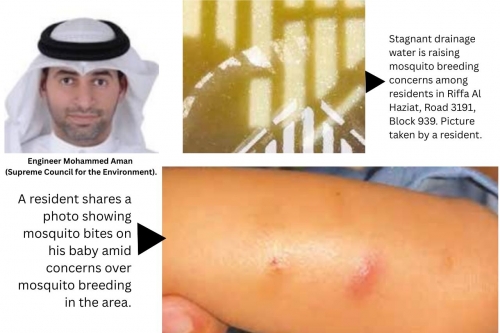
Amid ongoing government efforts to curb mosquito growth across Bahrain, public reporting is emerging as a key tool in tackling breeding hotspots, as residents continue to flag problem areas where stagnant water has created favourable conditions, particularly near construction and drainage sites.
Authorities have urged residents to play an active role by ensuring proper waste disposal and reporting standing water or sanitation issues via 80008188. The Health Ministry also warned that mosquito activity typically increases during periods of rainfall, moderate temperatures and high humidity, urging the public to remove stagnant water from containers, tyres and drains.
As previously reported by The Daily Tribune, Engineer Mohammed Aman from the Supreme Council for the Environment said during a recent “Hayaakom” session organised by the Northern Municipal Council that “citizens are the eyes of environmental protection,” calling for stronger sanitation practices and cooperation to address root causes.
Residents across several areas continue to raise concerns over localised mosquito breeding conditions.
Speaking to TDT recently, resident Aswin Tamang said that near his home in Riffa Al Haziat, stagnant water had collected near a construction-linked drainage area following recent works, creating persistent mosquito problems despite preventive measures taken inside homes.
“We are doing everything for the mosquitoes, but I don’t know where they come from and enter our rooms,” he said, adding that the issue is particularly worrying for families with small children.
ACTION
Bahrain has stepped up nationwide mosquito control measures. In April, the Cabinet, chaired by HRH Crown Prince and Prime Minister Salman bin Hamad Al Khalifa, ordered urgent action to strengthen monitoring, containment and response efforts aimed at preventing mosquito-borne diseases, including dengue.
Following this, the Ministry of Municipalities Affairs and Agriculture and the Ministry of Health expanded joint operations across all governorates, including inspections, pest control and water removal drives, alongside efforts to clear waste and stagnant water breeding sites.
More recently, a proposal to install portable electric mosquito traps in public spaces was referred to the Cabinet as part of ongoing discussions to strengthen mosquito control measures.
The Northern Municipal Council had previously proposed involving specialised private companies to support mosquito control efforts and improve response times during outbreaks.
Health experts note that mosquito bites, while common in Bahrain, can cause itching, swelling, pain and sometimes infection, stressing that prevention begins at home through removing stagnant water, maintaining drainage, covering containers and using repellents.
Meanwhile, Bahrain’s Public Cleanliness Law prohibits activities that allow water to flow into streets or public areas, reinforcing the need to prevent stagnant water build-up.
Related Posts