

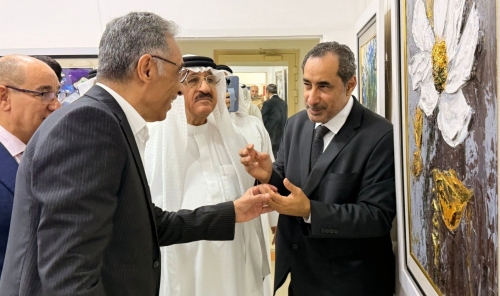
When the Legends of Dilmun Awaken in Contemporary Art
Under the patronage of Professor Abdullah Yusuf Al-Hawaj, Founder President and Chairman of the Board of Trustees of Ahlia University, Abaad Gallery opened a visual journey where heritage and modern brushwork converge.
On Tuesday evening, May 12, 2026, the solo exhibition of visual artist Mahmoud Abdul-Sahib Baklawa titled “Inzak… Dilmun Symbolic Signs” was inaugurated. The event drew a remarkable turnout of art enthusiasts, intellectuals, and academics, all tracing the artist’s reawakening of Bahrain’s cultural memory.
The exhibition was not a reproduction of artifacts, but an artistic laboratory where Dilmunite elements—seals, cuneiform writing, and ritual symbols—were reinterpreted into a contemporary visual language. Under the title “Inzak,” referencing the ancient Dilmun deity, Baklawa presented works layered with spiritual resonance, using color techniques and visual strata to bridge present perception with a heritage stretching back five thousand years.
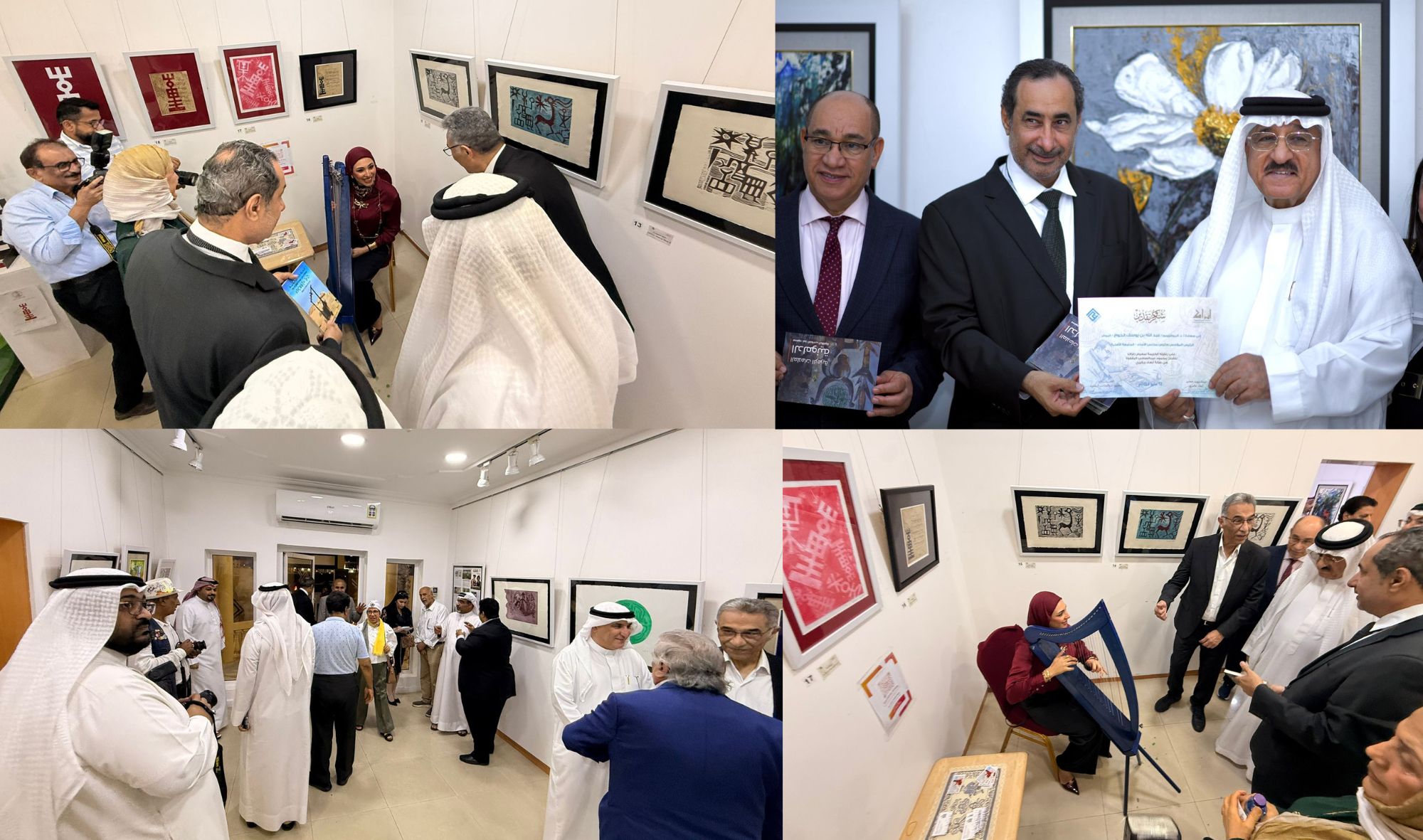
During his tour of the exhibition, Professor Al-Hawaj emphasized the academic and cultural significance of such initiatives. He stated:
“The artist Mahmoud Al-Baqlawa's experience in 'Inzak' represents a practical model for utilizing cultural heritage to strengthen national identity through visual methodologies.”
He further stressed that supporting artistic talent reflects an investment in Bahrain’s symbolic capital, turning history into a living narrative rather than static museum memory.
For his part, Baklawa described his project as a long visual exploration of ancient semiotics. He said:
“My aim was to re-encode the historical symbol not as a sacred relic, but as a flexible aesthetic force that engages the spirit of the contemporary viewer. I try to make the Dilmun seal breathe into the canvas, and the cuneiform script dance across the surface like visual poetry.”
Academics and critics praised the exhibition’s chromatic harmony and its ability to transform cuneiform script into abstract aesthetic forms. Many regarded it as a shift from documentation toward a “visual philosophy” of heritage.
The support of Professor Al-Hawaj underscores the university’s continued commitment to fostering cultural partnerships, reinforcing its role in shaping Bahrain’s creative landscape and connecting new generations to their heritage through innovative artistic expression.
In this encounter, Dilmun does not remain in the past—it reappears, reframed, and visually spoken in the present.
Related Posts