

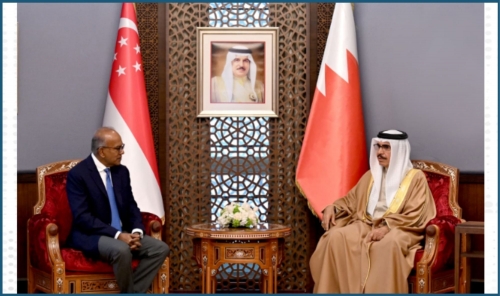
Bahrain, Singapore Agree to Form Joint Security Coordination Committee
His Excellency Shaikh Rashid bin Abdullah Al Khalifa, Minister of Interior, received Singapore’s Coordinating Minister for National Security and Minister for Home Affairs, K. Shanmugam, and his accompanying delegation on Tuesday, in the presence of several senior officials from the Ministry of Interior.
Upon the delegation’s arrival at the Police Fort, an official salute was performed before the two ministers proceeded to the meeting hall. Shaikh Rashid welcomed the Singaporean minister, expressing hope that the visit would further strengthen security cooperation and coordination between the Kingdom of Bahrain and the Republic of Singapore, in line with the close relations shared by both countries.
The Interior Minister praised the strong bilateral ties and the mutual commitment to developing them in ways that serve the interests of both nations and their peoples. He highlighted the importance of exchanging expertise, particularly in the use of modern and digital technologies, to enhance the efficiency and quality of security services.
Shaikh Rashid also stressed the importance of addressing shared security challenges, noting the significance of joint action within the framework of both countries’ membership in the International Security Alliance, headquartered in Abu Dhabi.
During the talks, the Interior Minister emphasised the need to continue joint efforts to confront security challenges and strengthen civil protection and public safety measures. He underscored the importance of expanding cooperation in the use of advanced technologies and artificial intelligence, alongside the exchange of expertise between the two sides.
Discussions focused on enhancing cooperation in training, knowledge exchange, and combating financial and economic crimes. The talks also explored collaboration in the use of drones, Singapore’s experience in strategic planning, and the application of science and technology in security and border control systems. In addition, both sides reviewed training and development programmes and the streamlining of procedures through digitalisation to improve institutional performance, quality, and oversight mechanisms.
At the conclusion of the meeting, both sides agreed to sign an agreement regulating police cooperation across several areas. They also agreed to establish a joint follow-up and coordination committee to support technological development within the security sector, strengthen technological infrastructure, and expand the use of artificial intelligence applications.
Related Posts