

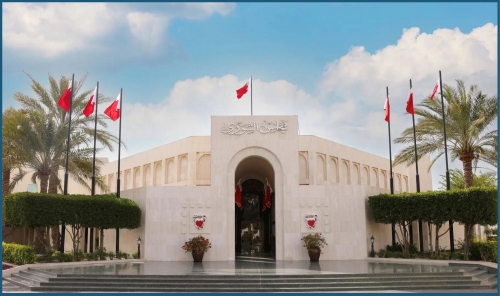
Shura Council to Debate Ad Bill, Child Digital Safety Law and Reserve Account Losses
Advertising on public buildings, child safety online and the Future Generations Reserve Account are all on the Shura Council’s agenda for its Sunday sitting.
Members will first consider the Public Utilities and Environment Committee’s report on a draft amendment to Article 12 of Decree-Law No. 14 of 1973 on the regulation of advertisements, attached to Decree No. 27 of 2025. The amendment would give government bodies a legal basis to use vacant areas in public buildings, or parts of buildings assigned to public services, as advertising space. The terms, conditions and controls for this use would be issued by ministerial decision.
According to the committee, the proposal completes earlier work to reorganise the advertising sector in Bahrain. The draft widens the scope for using public buildings for advertising purposes, and allows parts of service buildings to be used in this way, subject to rules issued by the minister.
The committee noted that the measure is expected to increase municipal income through advertising licence fees and to raise state revenue from better use of these spaces. It said the approach is designed to balance the work of public facilities with economic development needs.
The Council will also examine a Women and Child Affairs Committee report on a proposed amendment to the Child Law, issued by Law No. 37 of 2012. The proposal would add a third chapter titled ‘Child Digital Safety’, aimed at protecting children in the digital age while taking into account Bahrain’s legal framework and current use of online platforms.
In its report, the committee said the proposal seeks to extend legal protection for children to risks arising from digital use. It introduces graded protection, moving between prohibition and regulation according to age groups. Digital platforms used for educational purposes are excluded from the scope of the draft; they would be named in a decision issued by the Minister of Education.
The committee recommended allowing the proposal to proceed to discussion. It was submitted by Dr Jehad Al Fadhel, Jamal Fakhro, Dalal Al Zayed, Dr Ali Al Rumaihi and Khalid Al Maskati.
The committee gave several reasons for its recommendation. It stated that digital safety falls within the wider concept of legal protection for children and that including it in the law is required by current patterns of online use. It pointed to the emergence of new forms of exploitation, breaches of privacy and exposure to harmful content, which the draft seeks to address by regulating children’s use of digital platforms.
The report noted that bringing digital safety into the existing Child Law is consistent with the law’s preventive aims and keeps all child-protection rules within one statute, rather than dispersing them across different pieces of legislation.
The committee also said the proposal seeks to balance protection from digital risks with the right to education by excluding platforms used for teaching purposes. Those platforms would be named in a decision by the Minister of Education, in view of the role of e-learning tools in the school system.
The text introduces an express legal ban on creating accounts on digital platforms for children under the age of fifteen. The committee said this age group is the most affected by online content and has the least ability to judge such content or to meet self-protection requirements. It added that the ban is in line with existing policy in Bahrain, which grants special legal protection to this group.
The Council will in addition examine two reports by the Financial and Economic Affairs Committee on the annual reports and audited financial statements of the Future Generations Reserve Account for the financial years ending 31 December 2022 and 31 December 2023, which were reviewed by the National Audit Office.
The committee stated that the account is one of the tools the state uses to preserve resources, protect and grow assets and secure the rights of future generations to a decent life and a safe future. On this basis, it stressed the need to maintain the funds of the account and to invest them.
According to the report, the total funds received from the Ministry of Finance and National Economy for the benefit of the account reached 54,525,990 US dollars by the end of 2022. In the 2023 financial year, funds received were about 92.4 million US dollars.
The committee recorded that the 2022 financial year ended with a loss of about 71 million US dollars, due to the revaluation of investments under the applicable accounting bases, compared with a profit of nearly 51 million US dollars in 2021. It attributed the 2022 loss to global market conditions, including sharp price swings, falling asset values and tighter monetary policy.
For 2023, the committee reported a profit transferred to the reserve account of about 64 million US dollars, compared with the loss booked in 2022. It noted that this result points to an improvement in the account’s performance. The committee recommended continued work to diversify investment portfolios and maintain a balanced geographical spread in order to seek higher income and limit losses where possible.
The report stated that total assets reached about 768.9 million US dollars in 2023, compared with the previous year. The committee expressed in its 2022 report the hope that the account’s management would preserve its holdings and increase its assets to support the fund’s continuity and its stated aims. In its 2023 report, it noted the efforts made to increase the fund’s assets in that year.
On operating expenses, the committee said costs for 2022 fell to about 5.5 million US dollars compared with 2021. It called on the Future Generations Reserve Board to review the reserve’s operating expenses and to study administrative fees charged for investment portfolios, given that the board is made up of members with investment expertise, with the aim of raising the account’s performance. Operating expenses for 2023 were about 6.1 million US dollars, an increase of 9.5 per cent on 2022.
The committee suggested that it would be preferable to examine the option of paying the reserve’s expenses directly from the account, in order to ease recurring pressure on the state budget and to give a clearer picture of the reserve’s financial position.
Related Posts