

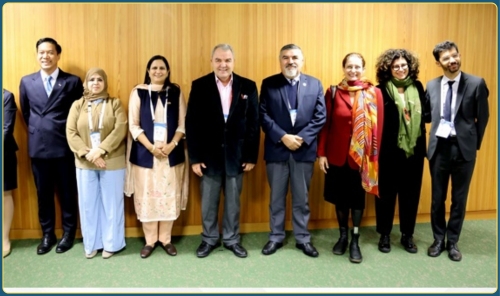
Bahrain Showcases Landmark Justice Reform Model
Bahrain’s pioneering justice reform initiatives took center stage at the 151st General Assembly of the Inter-Parliamentary Union (IPU), as Shura Council member and lawyer Dalal Jassim Al Zayed presented the Kingdom’s progressive experience in implementing the Alternative Sentencing and Open Prisons Program to an audience of international parliamentarians and UN representatives.
During the session of the Committee to Promote Respect for International Humanitarian Law, Al Zayed delivered a detailed presentation highlighting Bahrain’s human-rights–driven approach to justice reform—an approach inspired by the visionary directives of His Majesty King Hamad bin Isa Al Khalifa, and supported by the government led by His Royal Highness Prince Salman bin Hamad Al Khalifa, Crown Prince and Prime Minister.
She emphasized that Bahrain’s model reflects a modern balance between justice, rehabilitation, and societal protection, noting that the government continues to allocate dedicated budgets and launch initiatives to strengthen the system in alignment with the Alternative Sanctions and Measures Law.
Al Zayed described Bahrain’s reforms as a transformative shift in the criminal justice landscape—anchored in rehabilitation rather than retribution, and designed to uphold human dignity while fostering reintegration into society. The Kingdom’s framework enables the judiciary, public prosecution, and the Ministry of Interior to apply personalized, humane alternatives to incarceration that reflect the offender’s circumstances and the gravity of the crime.
Since the law’s implementation in 2018, thousands of eligible individuals have benefited, she said, noting that 97.5% of participants in the open prisons program successfully complied with its terms—an achievement that demonstrates its effectiveness in reducing recidivism and nurturing responsibility and discipline.
Al Zayed praised the Ministry of Interior’s critical role in executing the programs through targeted vocational, psychological, and social training—often in collaboration with civil society and private sector partners—to prepare beneficiaries for a smooth return to community life.
The open prisons facilities in Bahrain have also earned international accreditation from the American Correctional Association (ACA), Al Zayed announced—marking a global endorsement of Bahrain’s compliance with international human rights standards and restorative justice principles.
She underscored that Bahrain’s alternative sentencing philosophy aligns with the core tenets of international humanitarian law, promoting justice that rehabilitates rather than solely punishes.
Concluding her address, Al Zayed urged fellow IPU members to study Bahrain’s experience and consider adopting national frameworks for alternative sentencing, proposing that parliaments establish committees to evaluate their impact on public safety and human rights. She also called for the creation of an IPU reference guide to share best practices globally—making justice a bridge for human renewal, not merely a tool for punishment.
Related Posts