

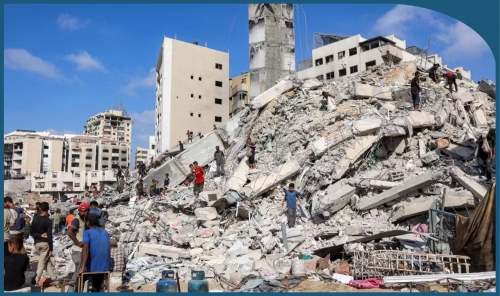
Gaza Residents Left Homeless as Israeli Strikes Flatten High-Rise Buildings
For ten years, Palestinian bank worker Shady Salama Al-Rayyes had been paying off a $93,000 mortgage on his apartment in a modern high-rise in one of Gaza City’s prime neighborhoods. That life came to an abrupt end when an Israeli demolition strike on September 5 reduced the 15-storey Mushtaha Tower to rubble, leaving him and his family destitute.
The attack marked the beginning of an intensified Israeli military campaign targeting high-rise buildings in Gaza City, ahead of a broader ground offensive aimed at the densely populated urban center. Over the past two weeks, Israel has demolished up to 20 tower blocks it claims are used by Hamas, while Prime Minister Benjamin Netanyahu stated that 50 "terrorist towers" have been destroyed.
The campaign has displaced hundreds of families. Residents in neighborhoods including Zeitoun, Tuffah, Shejaia, and Sheikh al-Radwan reported widespread destruction, a claim corroborated by satellite imagery showing damage to dozens of buildings.
Al-Rayyes, who plans to move south with his family, expressed fear that the demolitions are intended to permanently clear Gaza City’s population, a concern echoed by the U.N. Human Rights Office (OHCHR). Thameen Al-Kheetan, OHCHR spokesperson, said that deliberately relocating civilians could constitute ethnic cleansing.
“I never thought I would leave Gaza City, but the explosions are non-stop,” Al-Rayyes said. “I cannot risk the safety of my children.” He added, however, that he has no intention of leaving Gaza entirely.
Israel’s finance minister Bezalel Smotrich previously stated that much of Gaza could be "totally destroyed," confining its population to a narrow strip along the Egyptian border. The Israeli military has also closed a northern Gaza crossing, further restricting access to food and essential supplies.
In response to inquiries, Israeli military spokesperson Lieutenant-Colonel Nadav Shoshani denied a strategy to flatten Gaza, stating the goal is to target Hamas and rescue hostages. He argued that high-rise buildings were used by Hamas for surveillance, attacks, and to trap Israeli soldiers with explosives, and claimed civilians were used as human shields—allegations Hamas denies.
Internal sources suggest that political and military objectives in Israel are not always aligned, with some plans involving potential population displacement in Gaza diverging from military goals. The Prime Minister’s Office did not respond to requests for comment.
The current offensive is part of Israel’s broader war in Gaza, which has killed over 65,000 Palestinians, caused famine, and displaced large segments of the population following Hamas attacks in Israel on October 7, 2023. Those attacks killed 1,200 Israelis and left 251 hostages, with 48 still held in Gaza.
A recent U.N. inquiry concluded that Israel’s actions in Gaza could constitute genocide, a finding Israel called “biased and scandalous.” U.N. experts have warned that destruction of civilian infrastructure may amount to war crimes. Shoshani emphasized that the demolished buildings were legitimate military targets approved by intelligence and legal officers.
Related Posts