

The Two-State Solution: A Path to Peace
At last, there appears to be a glimmer of hope at the end of a long and tragic tunnel. Regional and global leaders are once again seriously considering a resolution to the decades-long conflict between Palestine and Israel. The proposal on the table is not new; in fact, it is the simplest and most enduring solution — the two-state solution.
We cannot forget the early and principled stance taken by His Royal Highness Prince Salman bin Hamad Al Khalifa, the Crown Prince and Prime Minister of The Kingdom of Bahrain, during the initial days of the war. His words were unambiguous. While condemning the attacks on Israel, he firmly opposed the ongoing war and the killing of innocent civilians. He reminded the world that Bahrain stands with the ordinary people caught in the crossfire, not with the machinery of war. He urged Palestinian leaders to release hostages and called on Israel to cease military aggression. His vision, once again, pointed to the same path the world keeps returning to: a twostate solution.
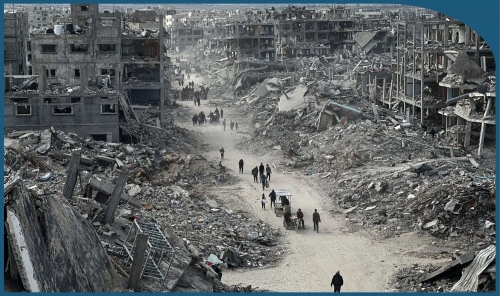
Looking back, one must ask — why has no alternative or innovative idea emerged to break this cycle of violence? The absence of decisive action and the neglect of wise voices from the Arab world and beyond have come at a terrible cost. More than sixty-eight thousand lives have been lost, and vast swathes of land and property have been reduced to rubble. Did anyone truly benefit from this war? The answer, unequivocally, is no.
It is worth recalling that the “Peace to Prosperity” conference was held in Bahrain in 2019. It was an ambitious attempt to refocus attention on the humanitarian and economic side of the Israel-Palestine conflict, with the hope that better livelihoods could help pave the way for peace. Yet, as with many well-meaning initiatives, it was dismissed or ignored. In the meantime, an entire generation of children has suffered irreparable trauma. Pregnant women, the elderly, and ordinary families have borne the brunt of this conflict. The scars of loss and destruction will take decades to heal — if they ever do.
This tragedy reminds us of a fundamental truth: leadership is not about vengeance or proving strength through destruction. It is about the courage to pursue peace, to admit mistakes, and to resolve disputes through diplomacy and dialogue. Some progress has been made, with countries such as the United Kingdom, France, Canada, Australia, and Portugal moving to recognise the State of Palestine formally. But recognition alone does not resolve the hard questions that remain. Critical issues still need to be addressed, including the division of land and the setting of borders.
The two-state solution may not be perfect, but it remains the only viable path forward. The time for hesitation has long passed. What is needed now is political will, moral clarity, and the recognition that peace is not a weakness — it is the strongest legacy any leader can leave behind.
(The author is Chairman and Managing Editor of The Daily Tribune and News of Bahrain)
Related Posts