

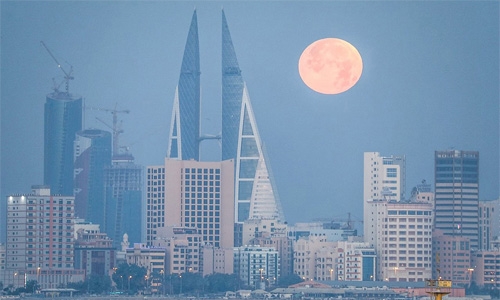
‘Cold Moon’ to adorn Bahrain sky early today morning
TDT | Manama
The Daily Tribune – www.newsofbahrain.com
Don’t miss it! The sky of the Kingdom of Bahrain will witness today the first full moon in the winter season, which is known as “Cold Moon”, the last astronomical phenomenon for this year.
It can be seen by the naked eye exactly at 0328 December 30 GMT (6:28am local time in the Kingdom), according to NASA’s SkyCal site.
Sky gazers will be able to see the 13th full moon of the year — yes, this is one of those occasional years with 13 full moons, including a “Blue Moon”. The “Cold Moon” will bring an end to an exciting month for astronomy buffs. It comes after a series of celestial events in the month including the ‘Great Conjunction’ of Jupiter and Saturn on December 21 and the Geminids meteor shower.
We also saw the rare Halloween Blue Moon on October 31, after 19 years. According to the space.com, “This particular Cold Moon will rise accompanied by Mars, which will be high in the southern skies just after sunset, as well as Jupiter and Saturn...” The nickname “cold moon” comes from Native American tribes, in this case the Mohawks that gave a nickname to each full moon throughout the year.
The cold refers to the dropping temperatures that start showing up as winter officially sets in. While full cold moon is the most popular nickname, there are a few others according to the Farmers’ Almanac and its competitor, the Old Farmer’s Almanac. It is sometimes referred to as the Full Long Night’s Moon or the Moon before Yule. For the next three days after this event, the moon will appear to be full-blown.
The Yule refers to the Pagan celebration of the winter solstice — the moment winter officially starts. As for the “long night” nickname, the Farmers’ Almanac notes it is “because the midwinter night is indeed long, and because the moon is above the horizon for a long time. The midwinter full moon has a high trajectory across the sky because it is opposite a low sun.”
In the southern hemisphere, where the seasons are flipped, the full December moon is often called the Strawberry Moon, Honey Moon or Rose Moon. In the northern hemisphere, the Strawberry Moon is in June. The next full moon is only a month away.
The first full moon of 2021, nicknamed the full wolf moon, will be shining on January 28 at 2:16pm, Eastern Time. January’s full moon has been known as a Wolf Moon for thousands of years.
Ancient civilisations tracked the changing seasons by the lunar months rather than the solar calendar, naming the months after features they associated with the northern hemisphere seasons including howling wolves. These names are now used to identify the full moons.
Related Posts