

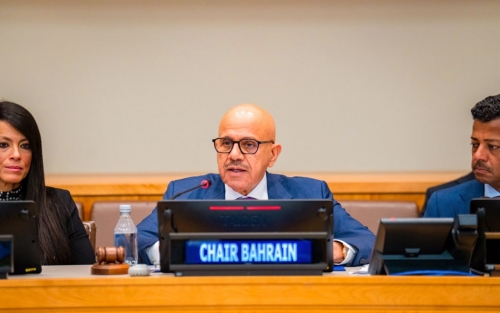
Growing Threats to Global Shipping
Bahrain Leads UN Push to Protect Maritime Routes
TDT | Manama
Email: mail@newsofbahrain.com
"Bahrain will continue
supporting maritime security and
Bahrain has taken its maritime security concerns to the UN Security Council, calling for stronger practical measures to protect freedom of navigation and prepare for disruptions along vital international sea routes.
Foreign Minister Dr. Abdullatif bin Rashid Al Zayani chaired an Arria-formula meeting organised by Bahrain at the UN headquarters in New York under the theme “Safe Seas, Shared Security: Protecting Freedom of Navigation in a Changing Security Environment.”
The meeting followed a high-level open debate on maritime security held during Bahrain’s presidency of the Security Council in April 2026.
The latest session was held against the backdrop of developments affecting navigation in the Strait of Hormuz, Bab Al Mandeb and the Red Sea following Iran’s closure of the Strait of Hormuz and disruption of maritime traffic.
The discussions focused on moving from identifying maritime risks to strengthening the international community's practical ability to prevent, prepare for, respond to and recover from major disruptions to maritime navigation.
More than 50 speakers participated in the meeting, with briefings from senior representatives of the UN Economic and Social Commission for Western Asia (ESCWA), the UN Conference on Trade and Development (UNCTAD), the International Labour Organization, the International Chamber of Shipping, and the University of Copenhagen and UN Institute for Disarmament Research.
The speakers highlighted the wider economic and security consequences of maritime disruptions, noting that more than 80 percent of global merchandise trade by volume is transported by sea.
ESCWA said the Strait of Hormuz accounts for around 25 percent of global seaborne oil trade and 19 percent of liquefied natural gas trade. It estimated the cost of the conflict during its first month at around USD 150 billion, equivalent to approximately 4 percent of regional GDP.
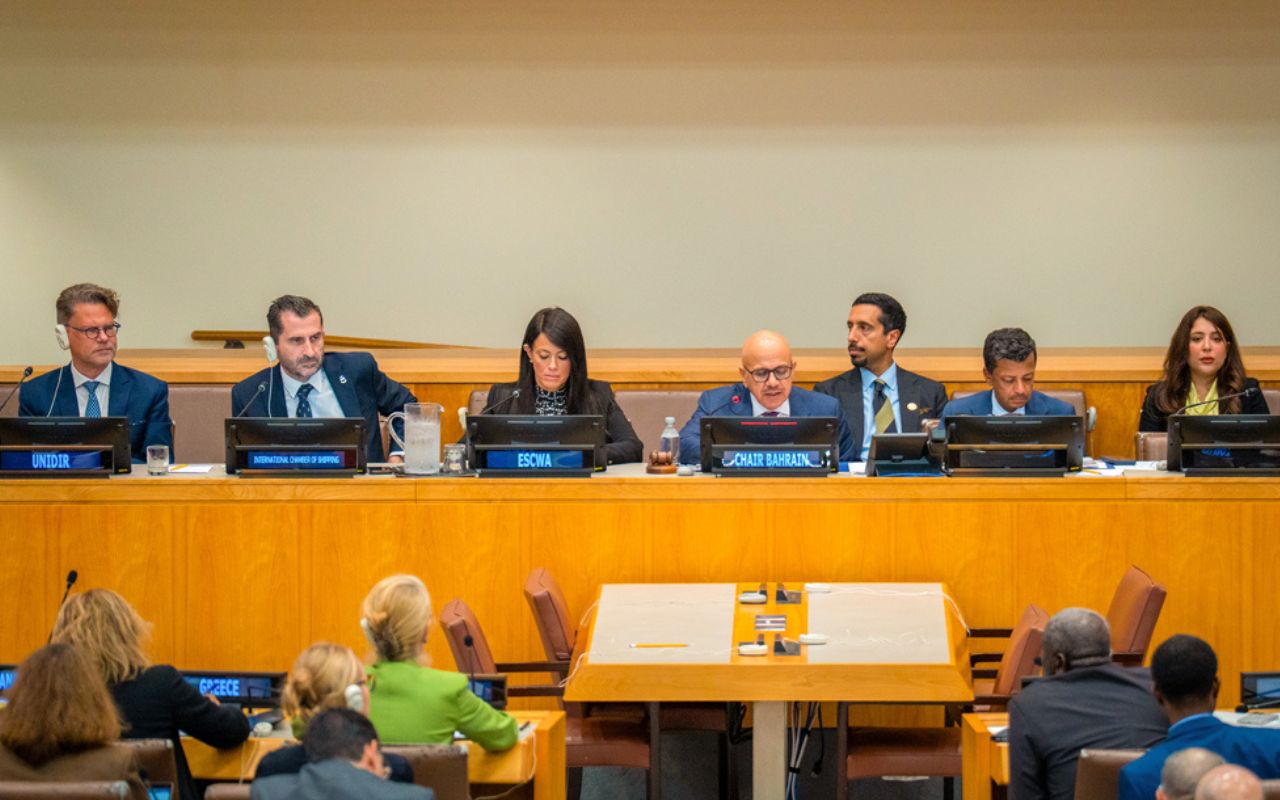
Addressing the Security Council, Dr. Al Zayani said Bahrain would continue to play its role in advancing maritime corridor security and freedom of navigation, both within the Security Council and beyond.
He said Bahrain would remain open to cooperation with partners that regard maritime security as a shared responsibility.
Dr. Al Zayani stressed that freedom of navigation is guaranteed under the UN Convention on the Law of the Sea and supported by the transit passage regime governing straits used for international navigation.
He also referred to the International Maritime Organization’s framework for preventing unlawful acts against the safety of navigation.
Turning to recent developments, Dr. Al Zayani cited the Strait of Hormuz as one example of the risks facing maritime security, saying Bahrain and several countries in the region had been subjected to Iranian attacks alongside threats to and disruption of maritime traffic through the strategic waterway.
He also pointed to Bab Al Mandeb, where he said the nature of the threat had evolved from attacks on passing vessels to an advance by the Houthi group towards the strait.
“There is a significant difference between targeting a particular vessel and a non-state armed group taking control of an international maritime corridor,” Dr. Al Zayani said.
Related Posts