

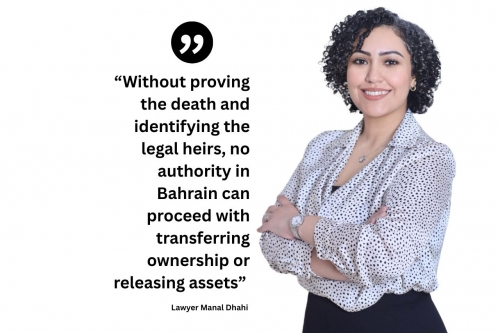
Navigating Inheritance in Bahrain
Lawyer Manal Dhahi explains how heirs can secure their rights and navigate inheritance procedures
TDT | Manama
Email: mail@newsofbahrain.com
What happens to a family home, a bank account, or a vehicle when its owner passes away? For many expatriate families in Bahrain, grief is often followed by uncertainty as they attempt to understand the legal steps required to access and transfer a deceased relative’s assets.
As Bahrain continues to attract foreign investors and residents who own properties, vehicles, businesses and bank accounts, questions surrounding inheritance have become increasingly common. To clarify the process, The Daily Tribune spoke exclusively to lawyer Manal Dhahi, Founder of Manal Dhahi Legal Consultations & Attorney.Dhahi explained that the law governing an expatriate’s estate depends on the type of asset involved. “Movable assets such as savings and cash deposits are generally distributed according to the law of the deceased’s nationality at the time of death,” she said.
“Real estate located in Bahrain requires the completion of transfer procedures in accordance with the laws and regulations applicable in Bahrain, with the submission of officially authenticated heirship documents issued by the deceased’s home country. The shares of each heir are then determined in accordance with the applicable law governing inheritance, which is generally the law of the deceased’s nationality.”
According to Dhahi, the first and most critical step is obtaining a death certificate and an official heirship certificate. If the death occurs outside Bahrain, the death certificate must be properly authenticated through the relevant authorities or bear an Apostille stamp where applicable.
Once the heirs are legally recognised, the process of transferring ownership begins. For real estate, heirs must submit the authenticated documents to the Survey and Land Registration Bureau, after which ownership can be transferred according to each heir’s legal share and the applicable inheritance law. In some cases, legal proceedings may be required to obtain a court order obligating the Survey and Land Registration Bureau to transfer ownership to the heirs according to each heir’s entitlement under the law of the deceased’s nationality.
Vehicles require a separate process through the General Directorate of Traffic. “The heirs must either agree on the transfer of ownership to a specific person or attend personally to complete the transaction,” Dhahi explained.
Bank accounts often present the greatest challenge. Financial institutions immediately freeze accounts once notified of a customer’s death. To access the funds, heirs must obtain court orders allowing banks to disclose balances and release the amounts for distribution.
“Banks in Bahrain apply strict procedures to protect depositors’ funds and ensure that distributions are carried out legally and fairly,” Dhahi said.
The same principle applies to company shares and commercial registrations. Heirs may be added as partners through amendments to company documents, or they may jointly decide to sell or liquidate the business.
Dhahi stressed that appointing one representative through a power of attorney can significantly simplify procedures, particularly when heirs live abroad. “Proper documentation and early legal guidance help families avoid delays and ensure that inheritance rights are protected,” she said.
With the correct legal steps, Bahrain’s inheritance framework provides a clear pathway for heirs to secure ownership of assets and settle estates in accordance with the law.
Related Posts