

Workforce Stability Plan
Shura to Consider Wide-Ranging Policy and Legal Changes
TDT | Manama
Email: mail@newsofbahrain.com
The Shura Council is set to debate a draft law that would temporarily allow Bahrain’s unemployment insurance fund to cover the wages of Bahraini workers for April 2026, a move aimed at supporting businesses and protecting jobs amid regional economic pressure.
The Ministry of Labour said the initiative is designed to help companies across all sectors retain Bahraini employees.
It stressed that labour market conditions are being closely monitored and that the measure is not expected to significantly affect the unemployment insurance fund's financial stability.
Officials from the Social Insurance Organisation noted that similar measures have been used in the past during periods of economic strain.
They added that the fund remains financially sound, supported by investment returns and regular actuarial reviews.
If approved, the bill would expand the unemployment insurance fund's role from post-jobloss support to a preventive tool aimed at sustaining employment during temporary economic challenges.
Council to Decide on Renaming of Arab Petroleum Body
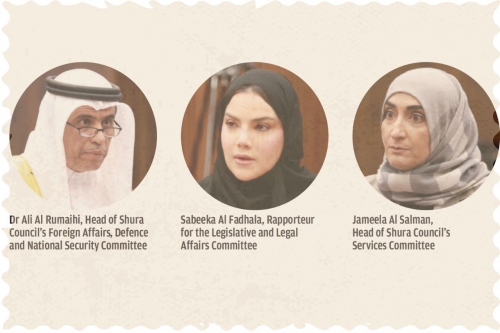
Dr Ali Al Rumaihi, Head of Shura Council’s Foreign Affairs, Defence and National Security Committee
One of the key reforms is removing the organisation’s judicial authority.
Dispute resolution would instead begin with amicable settlement, followed by arbitration if needed.
The proposal also cancels Bahrain’s Decree-Law No. 15 of 1978 related to the previous protocol framework.
Under the plan, Bahrain’s annual contribution will remain unchanged at BD210,000, imposing no additional burden on the state budget.
The amendments follow a 2024 resolution by the organisation’s Council of Ministers aimed at modernising its structure and expanding cooperation among member states. Kuwait will remain the headquarters, with the possibility of opening additional offices in other countries.
The revised agreement seeks to enhance Arab coordination in all energy sectors, support national companies, strengthen technical capabilities, and develop human resources.
Move to Replace Two-Thirds Requirement
Sabeeka Al Fadhala, Rapporteur for the Legislative and Legal Affairs Committee
This proposed amendment would reduce the current requirement from a two-thirds majority to a simple majority of members. Supporters say this change would remove a major procedural barrier and strengthen parliamentary oversight.
The bill has been endorsed by the Legislative and Legal Affairs Committee, which said the reform would enhance the elected chamber’s ability to use ministerial questioning as a key accountability tool. It involves amendments to Decree-Law No. 54 of 2002, which governs the internal rules of the Council of Representatives.
Under the proposed changes, interrogation requests would also follow a clearer process, allowing referral either to the relevant committee or directly to the full chamber. It further clarifies whether such sessions should be held publicly or in closed sittings depending on the circumstances.
Bill to Shorten Wait for Private-Sector Pension Loans
Jameela Al Salman, Head of Shura Council’s Services Committee
The proposal would amend Article 144 of Bahrain’s Social Insurance Law, allowing private-sector retirees to apply for a new substitution loan two years after their last loan, aligning the timing with public-sector retirees.
Currently, private-sector pensioners must wait two years after completing their last repayment before reapplying, while government retirees are eligible two years from the date of their previous substitution. The bill seeks to unify this calculation method.
The Shura Council’s Services Committee said the change would help remove disparities between the two groups and provide clearer, more consistent rules for retirees.
It also noted that the amendment would improve financial flexibility for pensioners facing urgent needs.
The Social Insurance Organisation supported the proposal, describing substitution loans as part of the social protection system rather than commercial lending.
Foreign Lawyers in Limited Cases
Dalal Al Zayed, Head of Shura Council’s Legislative and Legal Affairs Committee
The Shura Council is set to debate and vote next Sunday on a major draft law governing Bahrain’s legal profession, following its approval by Parliament and endorsement by the council’s Legislative and Legal Affairs Committee.
The proposed 68-article legislation, issued under Decree No. 16 of 2025, would fully replace the current legal framework and introduce wide-ranging reforms covering lawyer registration, trainee requirements, professional duties, legal fees, legal aid, and disciplinary procedures.
One of the key provisions would allow non-Bahraini lawyers to appear before Bahraini courts in limited and regulated cases, subject to ministerial approval and specific conditions set by the Supreme Judicial Council. However, criminal, administrative, sharia, personal status, tenancy, and labour cases would remain excluded from this provision.
The draft also introduces stricter professional standards, including requiring lawyers who have been inactive for extended periods to requalify and retake entry exams. Trainee lawyers would be required to complete a two-year training period, followed by exams and certification before entering full practice.
Vote on Dangerous Animals Law
Dr Mohammed Ali Hassan, Head of Shura Council’s Public Utilities and Environment Committee
The draft law, introduced under Decree No. 15 of 2025, seeks to close legal gaps by establishing clear rules for licensing, care standards, and enforcement measures.
It also expands the authority of the Ministry of Municipalities Affairs and Agriculture to inspect licensed facilities, review records, and take action against violations.
Under the proposed law, anyone who uses a dangerous animal to attack a person, resulting in permanent injury, could face three to seven years in prison.
If the attack leads to death, the penalty would be life imprisonment. Lesser violations, including keeping or trading such animals without a licence or breaching licence conditions, would carry fines between BD1,000 and BD10,000, or imprisonment, or both.
Companies could also be held liable, facing fines of up to BD20,000 if offences are linked to negligence or misconduct by senior officials.
Related Posts