

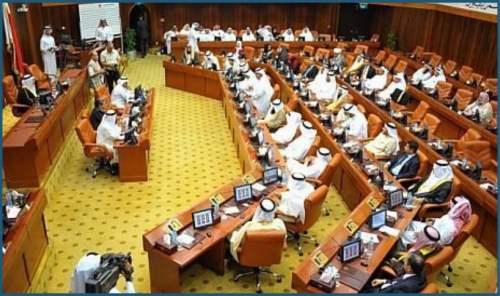
Shura backs BD 20,000 fines and private removals for unlawful adverts
Fines of up to BD 20,000 and the prospect of private firms tearing down unlawful billboards moved a step closer on Sunday after the Shura Council approved in full an overhaul of Bahrain’s advertising law, with a final vote due at its next sitting.
Members backed a draft law amending Decree-Law No. 14 of 1973 on the Regulation of Advertisements, attached to Decree No. 8 of 2025. The move follows the Council of Representatives’ earlier support for the same text, and comes after the Shura Council’s Legislative and Legal Affairs Committee confirmed that the draft is sound in constitutional and legal terms.
Committee rapporteur Ejlal Bubshait said the changes are built around a simple aim. ‘The draft law aims to reorganise the advertising sector in Bahrain so that it runs efficiently, is shielded from harmful practices and offers effective mechanisms to issue licences quickly and in an orderly way,’ she said, citing the Legislation and Legal Opinion Commission’s memorandum.
On paper, the bill is short. It carries five articles and a preamble. Across the old 1973 text, general references to ‘the ministry’ and ‘the minister’ are replaced with ‘the Ministry of Municipalities Affairs and Agriculture’ and ‘the Minister of Municipalities Affairs and Agriculture’. Articles 1, 6, 10, 16 and 17 are rewritten. A new Article 14 (bis) is added, allowing some tasks to be handed to other entities with Cabinet approval. Article 5, which had required the minister to form a committee from several bodies to oversee the law’s application, is removed. The final article deals with entry into force and implementation.
Municipalities Affairs Minister Wael Al Mubarak told members the existing rules were written for another era. ‘This law was issued more than fifty years ago, when the advertising market was very different. With the growth and evolution of this market, it has become necessary to develop the legislation that governs advertising,’ he said, adding that the draft draws on practice abroad and on experience in Bahrain.
The sharpest change sits in Article 16. Under the revised wording, the following acts would count as offences: placing adverts without a licence or in breach of its terms; giving false information or resorting to unlawful means to obtain a licence; and obstructing or delaying the work of ministry inspectors, or withholding records and documents they are entitled to see. Courts would be able to impose imprisonment, a fine between BD 1,000 and BD 20,000, or either of these penalties. Judges would also have to order the removal of unlawful adverts and the restoration of the situation to how it was before the breach, at the offender’s expense. The penalty would apply separately to each unlawful advert.
The committee said such a structure is needed because adverts are directed at the public or at large groups of people, and sanctions must be strong enough to deter those tempted to cut corners. It stressed that judges would keep leeway within the lower and upper limits of the punishments and would weigh each case according to the seriousness of the conduct.
Article 17 is reworked as well. Anyone who removes, breaks, tears, defaces or damages a licensed advert or part of it could face a higher fine, with the ceiling raised from BD 50 to BD 1,000. The committee said the old maximum was set in a very different economic climate and no longer matched the size and cost of modern campaigns.
Some members voiced concern about how repeated or cross-platform breaches would be treated. Shura member Dr Abdulaziz Abul warned against a reading of Article 16 that stacks penalties in a way he views as out of step with the current media scene. ‘If an unlawful advert appears across several pages, in more than one paper or on social media, will the penalty be multiplied by every page and every platform?’ he asked. ‘In this age of freedom of expression, multiple penalties of that sort do not sit well with the times.’
Second Deputy Chair Dr Jehad Al Fadhel told the chamber she would have preferred a complete rewriting of the 1973 law, given its age, rather than amending selected provisions. She also asked if passing inspection duties to outside parties amounts to a form of delegated privatisation, how the revised text fits with state policies in this field, and how penalties will be applied when an advertiser is based abroad and operates through campaigns inside Bahrain.
On the administrative side, the new Article 14 (bis) would allow the Ministry of Municipalities Affairs and Agriculture, with Cabinet approval, to assign some tasks under the law to other entities. Bubshait said this follows the pattern used with building permits, where engineering offices licensed by the Council for the Practice of Engineering Professions now handle part of the workload, which has helped shorten processing times while leaving the ministry as licensor and regulator.
Al Mubarak cast the change as a way to keep the ministry in charge while using outside capacity where needed. ‘An advert that threatens safety or carries unlawful content cannot be left in place for long, so assigning removal orders to a private entity allows the response to be much quicker,’ he said, noting that similar arrangements are already used in other municipal services. He added that foreign advertising firms operating in Bahrain must have a commercial registration and base in the kingdom, which allows sanctions to be enforced, while responsibility for breaches linked to unsafe structures would fall on the contractor that installed them.
The ministry told the committee that the bill is meant to bring order to the outdoor advertising market, curb random and harmful practices, improve the visual look of towns and cities and make licensing more predictable. It said the text gives it clear powers to inspect and control adverts, including the ability to take down unlawful material and suspend or revoke licences on a temporary or permanent basis.
By the end of the sitting, the Shura Council had approved the bill in its entirety, in line with the Public Utilities and Environment Committee’s recommendation, and agreed that a final vote on the law will be taken at its next session before it moves on through the remaining constitutional steps for ratification and publication.
Related Posts