

Governance, Growth and Generations
TDT | Manama
Email : editor@newsofbahrain.com
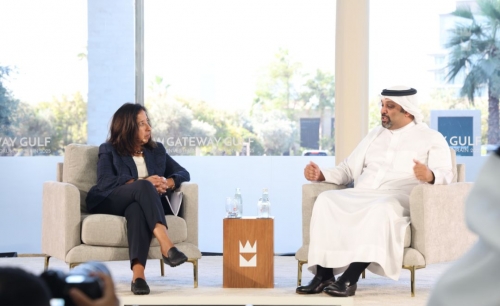
Bahrain’s Minister of Finance and National Economy, His Excellency Shaikh Salman bin Khalifa Al Khalifa, and Lubna Olayan, Chair of the Corporate Board of The Olayan Group and Chair of Saudi Awwal Bank, shared the stage at the Gateway Gulf Investment Forum in Manama yesterday, exploring how technology, governance, and leadership are reshaping the region’s economic landscape.
H.E. Shaikh Salman began the discussion by highlighting Olayan’s pioneering role in corporate governance across the region’s family enterprises. His Excellency noted that the group’s early adoption of strong internal structures and professional management had long set it apart.
Lubna Olayan recalled her late father’s advice when she became CEO. “My father told me to listen very carefully to lawyers and accountants, but not to let them make the decisions,” she said, smiling as she described his practical wisdom. She added that he “barely finished high school” yet “always went to the best advisers” and “was an amazing listener - listen, learn, and then make your decision.”
Asked whether the younger generation has it easier, Lubna said every era brings its own challenges. “Every generation has its challenges,” she said. “The pioneers had hard lives, and the young today live in the land of plenty - and that by itself is difficult.”
AI and inequality
The discussion turned to artificial intelligence, which both speakers described as a force that could either empower or disrupt. Lubna warned that while AI could improve lives, its misuse could deepen inequality. “One of my biggest worries is employment,” she said. “A stable country needs a large middle class. We have to make sure that AI does not cause the middle class to shrink and make the wealthy wealthier.”
She added, “If we can use AI to build up the middle class of our society, then I would say this is the right use of technology.”
Public-private drive
H.E. Shaikh Salman said the Gulf ’s advantage lies in the speed and scale at which governments can act to support private enterprise. “One of the advantages we have is the speed at which governments can move - deploying resources, pushing forward regulations and legislation, and focusing on upskilling human capital,” he said. “We like to say that the government has to do what we need to do and get out of the way of the private sector and let private enterprise make its capital allocation decisions.”
Lubna agreed, praising the cooperation between Gulf governments and family businesses. “Almost 60 to 65 percent of total GDP in the Gulf is due to family businesses,” she said. “I haven’t seen more cooperation between the private sector and government than I’ve seen here.”
Optimism and opportunity Lubna said she remains optimistic about the future despite global tensions. “Yes, I have worries - about geopolitics and about not keeping an eye on those left behind,” she said. “But I’m an optimist. I believe future generations will learn and correct what we have neglected.”
H.E. Shaikh Salman echoed that sentiment. “Whenever I want to get an optimistic view, I spend time with our young people - it refocuses how much opportunity we have and our duty to empower them,” His Excellency said.
The conversation closed on a note of shared confidence that the Gulf ’s public and private sectors are moving in tandem to build a sustainable, opportunity-driven future for the next generation.
Related Posts