Sydney : Environmental groups Monday urged greater action on climate change after the government sounded the alarm over severe coral bleaching in the pristine northern reaches of Australia'sGreat Barrier Reef.
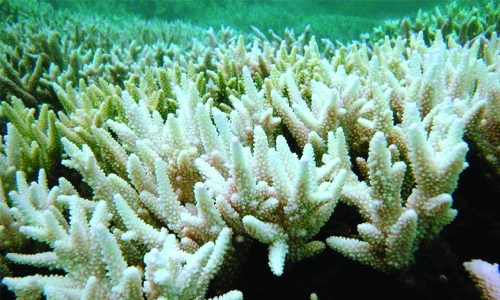
The government said Sunday that corals had turned white and grey in parts of the World Heritage-listed marine park, with the bleaching "severe" in northern areas.
Environmental group WWF said large sections of coral near Lizard Island were drained of all colour and fighting for survival.
"The reef can recover but we must speed up the shift to clean, renewable energy and we must build reef resilience by reducing runoff pollution from farms and land clearing," said WWF spokesperson Richard Leck.
Bleaching occurs when abnormal environmental conditions, such as warmer sea temperatures, cause corals to expel tiny photosynthetic algae, draining them of their colour.
Corals can recover if the water temperature drops and the algae are able to recolonise them.
The Great Barrier Reef Marine Park Authority said recent underwater surveys had detected "substantial levels of coral mortality" in the remote far north areas, blaming prolonged higher than average sea surface temperatures.
As a result, it has raised its response to level three the highest level in its response plan and indicating "severe regional bleaching".
"The pictures we're seeing coming out of the northern Great Barrier Reef are devastating," said Greenpeace Australia Pacific's Shani Tager.
"The Queensland and federal governments must see this as a red alert and act accordingly."
She called on the government to reconsider coal mining, saying the burning of the fuel was "driving climate change, warming our waters and bleaching the life and colour out of our reef".
Scientists had feared that the current El Nino weather phenomenon when the trade winds overthe tropical Pacific start to weaken and sea surface temperatures rise would impact the reef.
One of the worst mass bleaching episodes on record, which affected reefs in 60 tropical countries, took place in 1998 when the El Nino phenomenon was exceptionally strong.
But the independent crowd-funded Climate Council said while El Nino events had been experienced before, such severe bleaching would not occur without the influence of climatechange.