

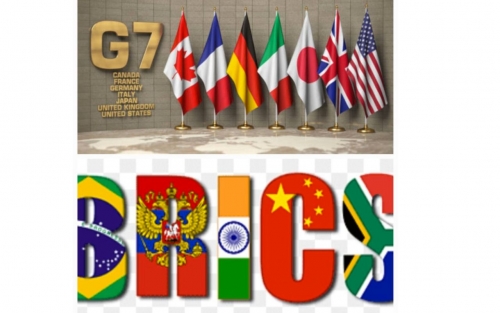
The BRICS Nations: A New Challenge to G7?
TDT | Manama
Email: mail@newsofbahrain.com
With six new nations joining it, BRICS, the now eleven-member bloc, is sure to have a stronger global sway—and a greater global say—than ever before.
Following a successful summit, the BRICS New Delhi Declaration, titled “Building for Resilience, Innovation, Cooperation and Sustainability,” was announced. It appears the road ahead for the global economy could change significantly, raising serious questions for the G7 (Group of Seven).
The G7 countries have a combined population of about 0.78 billion—roughly 9.5% of the world's population—while the expanded BRICS bloc represents about 3.9 billion people, or nearly 50%. This gives BRICS enormous demographic weight.
The demographic scale is largely driven by India and China, each with more than 1.4 billion people, alongside heavily populated nations such as Indonesia and Brazil.
But population alone does not tell the whole story. G7 GDP per capita is about $71,200, compared with only around $9,000 for the expanded BRICS bloc. The average citizen in a BRICS country, therefore, experiences a significantly lower level of income, living standards and economic productivity than someone in a G7 nation.
The G7 also remains considerably larger in nominal GDP, measured at market exchange rates. The combined nominal GDP of the G7 is about $55.3 trillion, representing 43.8% of the global economy, compared with $35.1 trillion, or 27.9%, for BRICS. The United States alone accounts for $32.4 trillion.
But here comes the interesting part.
When we measure economies using Purchasing Power Parity (PPP), the picture changes dramatically.
Nominal GDP converts currencies using prevailing market exchange rates. PPP, however, adjusts for differences in prices and the actual purchasing power of money in each country. A dollar, for example, can buy considerably more in an emerging economy than in a wealthy developed country.
As a result, although the G7 retains a commanding lead in nominal economic output and GDP per capita, BRICS represents a much larger share of the world's actual economic activity when measured by PPP.
Using data from the IMF World Economic Outlook, April 2026, for GDP and the UN World Population Prospects 2024 for population, I did some calculations using AI.
They show that BRICS' PPP-adjusted economy is approximately $80.4 trillion, representing about 40.7% of global GDP. The G7, by comparison, accounts for only about $58.6 trillion, or roughly 28%.
Simply put, the G7 is bigger in nominal dollars, but BRICS is substantially bigger in purchasing-power terms.
And this matters.
If a grouping representing roughly 41% of world GDP on a PPP basis and nearly half of the world's population can gradually increase the proportion of its trade settled in its own currencies, develop interoperable payment mechanisms and expand local-currency financing, the dollar's share of international transactions could decline—even without a BRICS currency ever being created.
The enormous PPP economic weight of BRICS, therefore, provides the bloc with the potential market needed to build an alternative financial ecosystem.
Its objective, however, is not necessarily to replace the dollar as the world's dominant currency, but to reduce the need to use it for trade, investment and cross-border payments among BRICS economies.
That, perhaps, is where the real challenge to the G7—and to the dollar-centred global financial system—could emerge.
Related Posts