

Europe-China spacecraft launches to study Earth’s ‘invisible armour’
AFP | Kourou
Email: mail@newsofbahrain.com
A joint European-Chinese spacecraft blasted into orbit yesterday to investigate what happens when extreme winds and giant explosions of plasma shot out from the Sun slam into Earth’s magnetic shield.
Particularly fierce solar storms can knock out satellites and threaten astronauts -- and create dazzling auroras in the skies known as the northern or southern lights.
To find out more about this little-understood space weather, the van-sized SMILE spacecraft is tasked with making the first X-ray observations of the Earth’s magnetic field.
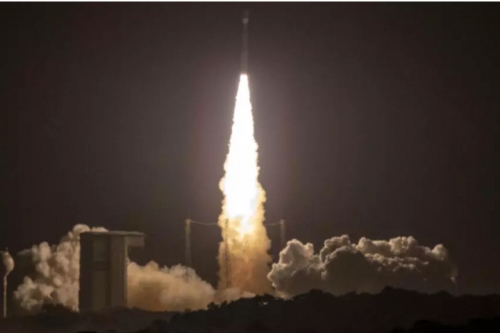
The spacecraft achieved liftoff on a Vega-C rocket at 0352 GMT on Tuesday from Europe’s spaceport in Kourou, French Guiana, on the northeastern coast of South America.
A little under an hour later, SMILE detached at 700 kilometres (435 miles) of altitude to make its own way toward an extremely elliptical orbit thousands of kilometres above the surface of the planet.
SMILE will be at an altitude of 5,000 kilometres when it flies over the South Pole, allowing it to transmit data to the Bernardo O’Higgins research station in Antarctica.
But the spacecraft will be 121,000 kilometres above the Earth when it swings over the North Pole -- an orbit the European Space Agency (ESA) says will allow the mission to “observe the northern lights non-stop for 45 hours at a time for the first time ever”.
SMILE -- or the Solar Wind Magnetosphere Ionosphere Link Explorer -- is a joint mission between the ESA and the Chinese Academy of Sciences.
“We are about to witness something we’ve never seen before -- Earth’s invisible armour in action,” ESA director-general Josef Aschbacher said in a statement. Project manager David Agnolon said SMILE “ marks the first time that ESA and China have jointly selected, designed, implemented, launched and operated a mission together”.
Related Posts