

Post-war security challenges
Qatar official urges stronger diplomacy amid global instability
A senior Qatari official called for stronger diplomatic engagement and collective international cooperation to address mounting global instability, warning that ongoing conflicts are reshaping political and economic relations worldwide.
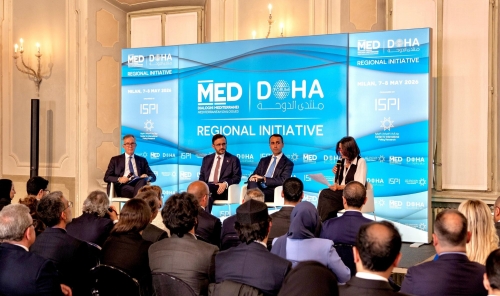
Dr. Majed bin Mohammed Al-Ansari, Advisor to the Prime Minister of Qatar and Official Spokesperson for the Ministry of Foreign Affairs, made the remarks during a session in Milan focused on cooperation between the European Union and the Gulf Cooperation Council in the post-war context.
The session, titled “Cooperation between the European Union and the Gulf Cooperation Council for Arab States after the Gulf War: Managing Instability and Reimagining Security,” was organized by the Doha Forum and the MED Dialogues, in partnership with the Italian Institute for International Political Studies and the Center for International Policy Research.
Al-Ansari said the current international environment is marked by overlapping crises and conflicts that complicate decision-making and undermine efforts to achieve stability. He warned that some actors promote narratives and policy approaches driven by strategic competition rather than long-term peace.
He stressed that political and military pressure alone cannot produce sustainable solutions, adding that mediation and diplomacy remain essential tools. According to him, skepticism about diplomacy’s effectiveness actually reflects a growing need for it.
The Qatari official also urged continued reliance on diplomatic channels and dialogue to prevent further escalation and avoid deeper cycles of conflict. He said the ongoing war has had wide-ranging consequences for international relations, including ties between Europe, the United States and countries in the Middle East.
He highlighted broader ripple effects on energy security, global trade, supply chains and geopolitical alignments.
Al-Ansari concluded that security and stability can no longer be achieved unilaterally, but require coordinated international action. He called for a shared framework to address accelerating regional and global challenges, noting increasing interdependence among states across political, economic and security dimensions.
Related Posts