

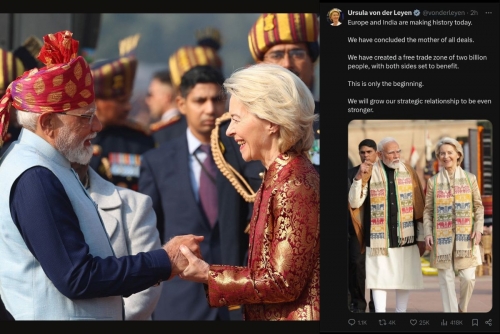
India and EU Finalise Landmark Free Trade Deal
Email: online@newsofbahrain.com
New Delhi: India and the European Union have finalised a long-pending free trade agreement (FTA) that leaders on both sides are hailing as a historic milestone in global commerce, Prime Minister Narendra Modi announced on Tuesday after nearly 20 years of negotiations.
Prime Minister Narendra Modi hailed the agreement as a “historic breakthrough,” while European Commission President Ursula von der Leyen described it as a foundational milestone for bilateral relations. The pact, often referred to by both leaders as the “mother of all deals,” aims to create a free trade zone covering nearly two billion people, representing around 25 % of global GDP and one-third of world trade.
In a tweet shared on X, European Commission President Ursula von der Leyen wrote that the pact marks a historic moment, saying: “Europe and India are making history today. We have concluded the mother of all deals... We have created a free trade zone of two billion people, with both sides set to benefit.”
Speaking at a summit in New Delhi, Mr Modi said the agreement will unlock “major opportunities for India’s 1.4 billion people and millions across Europe” and called it “a perfect example of a partnership between two major economies of the world.”
He emphasised the economic boost this pact is expected to deliver, particularly for India’s manufacturing and services industries, noting that it will enhance investor confidence and help integrate the Indian and European economies more closely. “Manufacturing will get a huge boost from this trade deal with the EU, and the services sector will also expand,” Modi said.
Officials said the agreement will lead to the elimination or reduction of tariffs on more than 90 % of goods traded between India and the EU, including machinery, chemicals and pharmaceuticals, while also aiming to strengthen cooperation in services and investment.
Under the terms agreed so far, India plans to reduce some steep import duties on European cars, cutting tariffs to around 40 % initially from very high levels and lowering them over time, a move expected to enhance European automakers’ access to India’s growing market.
Negotiators have worked since 2007, with talks revived in 2022 after an extended hiatus. The finalised agreement is designed to reduce or eliminate tariffs on over 90 % of goods traded between India and the EU, opening wide access for a range of products including manufactured goods, textiles and automotive components. It also addresses services, investment flows and regulatory cooperation, while retaining protections for sensitive sectors on both sides.
The deal has also been positioned as part of a broader strategic alignment amid shifting global trade dynamics, including escalating tariffs from the United States on both Indian and European exports. Modi and EU leaders stressed that this pact will strengthen economic resilience and provide new avenues for growth beyond traditional trade partners.
Before it can take effect, the agreement must undergo legal review and secure approvals from the European Parliament, the European Council and India’s Union Cabinet. Officials anticipate formal signing later in 2026 and an implementation timeline that could see the FTA become operational in early 2027
Related Posts