

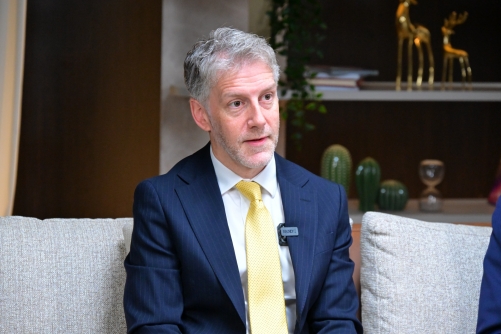
“Recognition of Palestine Is a Step Toward Peace — Not an Appeasement of Hamas,” Says UK Ambassador
TDT | Manama
Email : editor@newsofbahrain.com
The United Kingdom’s recognition of the State of Palestine is a strategic step to revive the peace process-not a concession to Hamas-stated His Excellency Alastair Long, British Ambassador to the Kingdom of Bahrain, in an exclusive interview with Al-Ayam and The Daily Tribune. He affirmed that Hamas has no place in Gaza’s future and reiterated that the two-state solution remains the only viable path to lasting peace and security for both Palestinians and Israelis. Ambassador Long also praised Bahrain’s constructive role, describing it as a responsible regional partner that supports dialogue, consensus-building, and the two-state framework.
Q: The UK announced its recognition of the State of Palestine on 21 September, a decision that sparked strong criticism from Israel, which accused London of “rewarding terrorism.” Prime Minister Netanyahu compared it to appeasing Hamas. Has this decision damaged relations between the UK and Israel, or is it a calculated difference the two sides can manage?
A: This decision is in no way an appeasement of Hamas. Hamas does not support the two-state solution, which our recognition seeks to advance. Its vision stands in direct opposition to peaceful coexistence between Israelis and Palestinians. The recognition by the UK, France, and other international partners has, in fact, helped generate an unprecedented Arab rejection of Hamas. We have remained in constant communication with Israel throughout the Gaza conflict and have been very clear about the need for a political process that leads to a two-state solution. Our support for Israel’s right to exist and the security of its people remains firm. However, the Israeli government must also take responsible steps, including halting illegal settlement expansion in the West Bank.
Q: The UK designates Hamas as a terrorist organisation and insists that recognition of a Palestinian state does not imply acceptance of Hamas in future governance. Given that Hamas still holds de facto control in Gaza, how can this principle be realistically implemented?
A: The UK’s position is clear: Hamas must be disarmed and must play no role in Gaza’s future. There is a broad regional and international consensus on this, and it is in the best interests of the Palestinian people. Our immediate focus is getting humanitarian aid into Gaza, but there is also an urgent need to establish better security arrangements that can deliver stability and gain the trust of people and parties involved. We are actively working on this with international and regional partners. Q: Less than 48 hours after the ceasefire took effect, reports emerged of Hamas carrying out public executions of civilians. Does the continued control of Hamas over Gaza pose a direct threat to regional stability and the peace process? A: The UK has been clear that Hamas cannot have any role in Gaza’s future governance. This position is in the interest of the Palestinian people and is widely supported across the region.
Q: The UK linked its recognition of Palestine to the start of a political process, a ceasefire, and a halt to settlement expansion. Following the Sharm ElSheikh Summit, have you seen actual commitment from either side, or is the agreement still largely aspirational?
A: It was critically important that we saw a ceasefire, the return of hostages, and the increasing flow of humanitarian aid. These are vital first steps. We never expected them to be easy, but this process must be fully supported. Our recognition, along with that of others, helped reach this point and reminded all parties of the ultimate objective. We are now working with regional and international partners to move from a temporary ceasefire towards a permanent end to the conflict.
Q: If the conditions attached to recognition are not met, would the UK reconsider its decision or adjust its support?
A: Recognition was a carefully considered decision. However, we have always said that recognition alone would not be enough to end the war. We must sustain the ceasefire and build from it towards lasting peace. That requires serious, coordinated diplomacy—the kind the UK promotes daily at the UN Security Council, where we have not used our veto in 36 years, choosing instead to build consensus for peace and security. We will continue using our experience and partnerships to generate momentum for Gaza’s recovery, reconstruction, and eventually a two-state solution.
Q: How does the UK assess the outcomes of the Sharm ElSheikh Summit? Can the international framework agreed there enforce real commitments from both Israelis and Palestinians?
A: For two years, we called for a ceasefire, the release of hostages, and humanitarian access to Gaza. We now have all three, along with new momentum to advance the next steps. The true challenge is implementation. Many international partners are working with determination on issues such as security, stability, and transitional governance in Gaza. Prime Minister Keir Starmer attended the summit, underscoring its importance. He also announced £20 million in UK aid to support water, sanitation, and hygiene services for civilians in Gaza.
Q: What specific role will the UK play in reconstruction, security arrangements, and institution-building in Palestine?
A: As a permanent member of the UN Security Council and a major donor, the UK is committed to supporting lasting peace. We are actively engaged with international and regional partners on Gaza’s security, transitional governance, and recovery. Any temporary arrangements must transfer control of Gaza to the Palestinian Authority as soon as possible. We currently support Palestinian security forces through training and expect them to play a key role in Gaza in due course. Civil society organisations will also be crucial in promoting accountability and transparency within future Palestinian institutions.
Q: What is the most realistic mechanism for reunifying Gaza and the West Bank under a reformed Palestinian Authority without triggering internal conflict?
A: We have always supported the eventual return of Gaza to the Palestinian Authority and the reunification of Gaza and the West Bank under its leadership. A secure Israel living alongside a viable, sovereign Palestinian state—led by a reformed Palestinian Authority—is the only sustainable path to peace. President Mahmoud Abbas has committed to reform, and the UK will support the PA as it undertakes this process.
Q: Following the recognition of Palestine, how do you view the role of Gulf states—especially Bahrain—in the next phase of the peace process?
A: His Majesty King Hamad bin Isa Al Khalifa has consistently supported peace throughout this tragic conflict. Bahrain’s principled and responsible commitment to the two-state solution demonstrates regional leadership and aligns closely with our own stance. Bahrain has proven to be a constructive partner and a bridge-builder in regional consensus, particularly during its presidency of the Arab League, and it continues to earn respect from all parties. Each Gulf state will determine its own role in supporting Gaza’s recovery, but Bahrain’s early and clear support gives it a prominent voice in this process.
Related Posts