

France Calls Recognition of Palestine a ‘Moral Duty and Political Necessity’
TDT | Manama
Email : editor@newsofbahrain.com
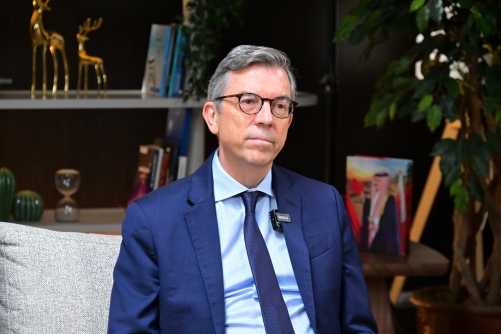
In an exclusive interview with Al-Ayam and and The Daily Tribune, the French Ambassador to the Kingdom of Bahrain, Eric Giraud-Telme, affirmed that France’s official recognition of the State of Palestine was both “a moral duty and a pressing political necessity,” driven by the ongoing war and humanitarian catastrophe in Gaza. He stressed that the move is not directed against Israel but rather intended to revive the two-state solution, which he said was “on the brink of collapse just a year ago.”
The ambassador revealed that France, Saudi Arabia, and ten other countries are working to establish an emergency coalition to ensure the financial sustainability of the Palestinian Authority. Since 2023, France has provided around €250 million to support Palestinian civilians. “We must flood Gaza with humanitarian aid and begin reconstruction immediately,” he said.
Q: France has officially recognized the State of Palestine. What prompted this decision at this particular moment?
A year ago, the two-state solution—the only realistic path to peace and stability—was facing an existential threat. Conditions had to be restored to make it credible again. That is why we committed to organizing an international conference with Saudi Arabia, under UN auspices. As a result, President Emmanuel Macron announced France’s recognition of the State of Palestine at the United Nations on 22 September. Faced with an endless war, the humanitarian catastrophe in Gaza, and growing unilateral actions on the ground, recognition became both a moral obligation and a political requirement.
Q: Was this recognition part of a coordinated European approach?
Within the EU, some member states had already recognized Palestine, while others did so alongside France. A few have not yet taken this step. The momentum created by France— along with commitments from the Palestinian Authority—encouraged more countries to join. Beyond Europe, we also coordinated with the United Kingdom. “Hamas is a terrorist organization and must be excluded from Gaza’s future governance”
Q: How does France assess the future governance of Gaza and the outcomes of the Sharm El-Sheikh Summit?
France welcomed the convening of the Sharm El-Sheikh Summit. President Macron attended to show support for implementing the first phase of the U.S. plan. In the coming weeks, France will co-host a humanitarian conference on Gaza with international partners to ensure sustained aid delivery and lay foundations for reconstruction.
Q: What commitments has France made toward rebuilding Gaza?
Since 2023, France has provided €250 million to Palestinian civilians. Along with Saudi Arabia and ten other partners, we are establishing an Emergency Coalition for the Financial Sustainability of the Palestinian Authority. As our Foreign Minister Jean-Noël Barrot said: “We must flood Gaza with humanitarian aid and start rebuilding now.”
Q: How does France view Hamas’ role after the war, especially amid reports of field executions?
France has condemned all actions that endanger civilians or undermine the ceasefire. Regarding Hamas, our position is firm: Hamas is a terrorist organization. As outlined in the New York Declaration backed by 142 states, Hamas must be excluded from any future governance in Gaza, and it must be disarmed. “A reformed Palestinian Authority must return to Gaza”
Q: What model of governance does France support for postwar Gaza?
France supports the return of a reformed and empowered Palestinian Authority to govern Gaza. This should take place within a short, agreed timeline. The peace plan proposes a “Peace Council” and a committee of Palestinian figures. France insists the Palestinian Authority must be fully included to ensure legitimate governance. “French-Saudi initiative shaped international momentum”
Q: How do the French-Saudi initiative and the U.S. peace plan align?
France and Saudi Arabia have worked for months under a UN mandate. This resulted in the New York Declaration and the Two-State Conference in September. The initiative was supported by 142 countries and helped inspire elements of the U.S. plan. What matters is the result, not who leads. We remain realistic—much work still lies ahead. “Bahrain’s UNSC seat is well-deserved and strategically important”
Q: How can France and Bahrain cooperate on Palestinian reconstruction and diplomacy?
On 1 January 2026, Bahrain will take its seat on the UN Security Council. This is a well-deserved achievement. France and Bahrain share similar positions, especially regarding the twostate solution. Reconstruction in Gaza will take time, but I am confident we will create joint pathways to support Palestinians politically, economically, and humanitarianly. “Recognizing Palestinian rights does not contradict support for Israel”
Q: How does France balance its support for Palestinian rights while maintaining relations with Israel?
France maintains friendly relations with both Israelis and Palestinians. We believe that peace can only be achieved through an independent, viable, democratic Palestinian state living alongside Israel in peace and security. Recognizing the rights of the Palestinian people does not diminish the rights of the Israeli people, which France has supported since day.
Related Posts