

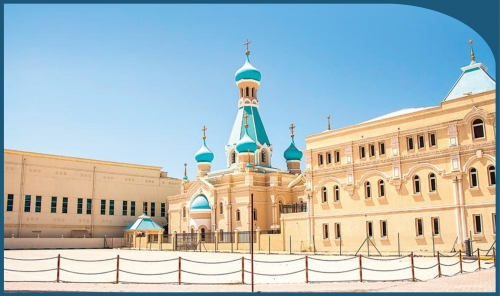
UAE Hosts 73 Licensed Non-Muslim Worship Centers
The United Arab Emirates, renowned for its cultural diversity with residents from over 200 nationalities, now hosts 73 licensed places of worship for non-Muslims, highlighting its commitment to religious tolerance.
According to the Ministry of Community Development, Abu Dhabi leads with 27 centers, followed by Dubai with 14, Ras Al Khaimah with 11, Sharjah with 10, Fujairah with 8, Umm Al Quwain with 2, and Ajman with 1.
The UAE has long positioned itself as a regional model for coexistence. This message was reinforced in 2019 when Abu Dhabi welcomed Pope Francis and Sheikh Ahmed Al Tayeb, Grand Imam of Al Azhar, for the signing of the historic Document on Human Fraternity. The United Nations later designated February 4 as the International Day of Human Fraternity to commemorate the occasion.
The establishment of new worship centers is governed by Federal Law No. 9 of 2023, which outlines strict requirements for non-Muslim religious facilities. Applicants must represent a recognized faith, have at least 20 founding members aged 40 or older, demonstrate a minimum of five years’ residency in the UAE, and show financial capability to build and operate the facility. Each application also requires endorsements from established religious authorities.
Non-Muslim worship has a long history in the UAE. Abu Dhabi is home to some of the region’s earliest churches, including St. Joseph’s Church, founded in 1965 on land gifted by Sheikh Shakhbut bin Sultan Al Nahyan. Other landmarks include St. Andrew’s Church (1968), St. George Orthodox Church (1970), and the Coptic Orthodox Church (1984). In 2006, Sheikh Mohammed bin Zayed Al Nahyan, then Crown Prince of Abu Dhabi, allocated land for the Church of Jesus Christ of Latter-day Saints, the first in the Gulf, which opened in 2013.
Dubai also boasts a long-standing Christian presence. St. Mary’s Catholic Church in Oud Metha, over 50 years old, now serves worshippers from more than 150 nationalities, offering services in 17 languages. The Jebel Ali area has become another center for diverse congregations.
In Sharjah, Ajman, and Umm Al Quwain, the Al Yarmouk complex stands out as a symbol of multi-faith coexistence, hosting 15 churches that cater to more than 170 nationalities, including Russian, Egyptian, Syrian, Indian, Ethiopian, Armenian, Italian, and Nepali communities.
The UAE also made history in 2015 by allocating land in Abu Dhabi for the Hindu Mandir, providing a dedicated space for the Indian community to practice their faith.
With these initiatives, the UAE continues to reinforce its vision of tolerance, coexistence, and respect for diverse religious traditions.
Related Posts