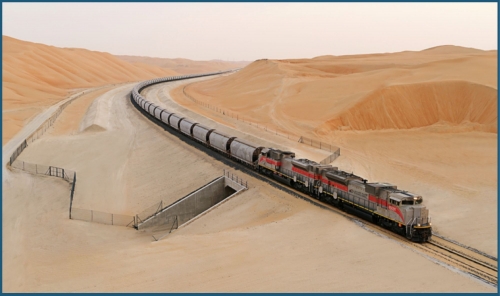
Etihad Rail has launched a nationwide awareness campaign aimed at encouraging logistics companies, manufacturers and heavy industries to transition long-haul freight transport from road to rail across the UAE.
The initiative comes as the country’s industrial and logistics sectors enter a new phase of expansion, increasing pressure on road infrastructure, delivery reliability and operating costs. Through the campaign, Etihad Rail positions rail freight not as a future alternative, but as an already operational, scalable and proven solution supporting the UAE’s industrial growth.
Spanning nearly 900 kilometres, Etihad Rail’s national freight network directly links ports, industrial zones and major logistics hubs. The network allows bulk and high-volume cargo to move on fixed schedules along dedicated corridors, offering greater predictability than road transport, which is increasingly affected by congestion and delays.
Each freight train can carry the equivalent load of up to 300 heavy trucks, significantly reducing traffic on major highways while providing manufacturers with greater certainty in meeting tight production timelines.
Omar Alsebeyi, Acting Chief Executive Officer of Etihad Rail Freight, said logistics for heavy industry is no longer focused solely on speed, but on reliability and consistency.
“Delays, congestion and volatility carry real costs,” Alsebeyi said. “Rail addresses these challenges by offering scale, reliability and predictability on a daily basis.”
The campaign highlights how rail freight can help companies stabilise transport costs, reduce inventory buffers and plan production more efficiently, particularly as shipment volumes increase. Etihad Rail stressed that the initiative is not intended to replace road freight, but to create a more balanced and efficient logistics system.
“Road transport remains essential, especially for last-mile delivery,” Alsebeyi added. “Rail removes long-haul and bulk movements from roads, easing congestion and allowing trucks to operate where they are most effective.”
The campaign will run across trade media, industry forums and digital platforms, supported by case studies showcasing improved efficiency for customers in sectors such as construction materials, petrochemicals, metals and containerised cargo.
The launch also aligns with national priorities to strengthen supply-chain resilience, enhance industrial competitiveness and future-proof logistics infrastructure as trade volumes continue to grow.
“The UAE has invested in a national rail network designed to support growth for decades,” Alsebeyi said. “Rail freight is operational, reliable and ready to scale. This is the time for industry to take full advantage of it.”
Etihad Rail said early adopters of rail freight are expected to gain long-term benefits, including lower costs, improved reliability and the ability to expand operations without adding pressure to already congested road networks.