

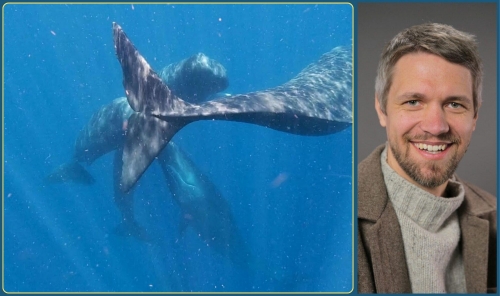
Scientists Discover Human-Like Vowel Sounds in Sperm Whale Communication
Study reveals that sperm whales may “speak” using structured vowel patterns, bringing scientists closer to decoding their secret conversations.
Researchers from the University of California, Berkeley and the CETI project announced in November 2025 that they had discovered vowel and diphthong-like spectral patterns in the clicks of sperm whales recorded in the Caribbean Sea, identifying why these animals may communicate with a level of complexity not previously recognised. The team discovered while analysing thousands of click sequences, known as codas, to determine what acoustic patterns whales produced, who used them, where they were recorded and why such structured signals might exist.
The research centred on the spectral structure of whale codas, which had traditionally been examined only in terms of the number of clicks and the timing between them. Earlier studies tended to view codas as rhythmic patterns rather than carriers of spectral information. However, by applying advanced spectrographic and frequency-based analysis, the researchers found that whale clicks contained highly organised formant-like structures, the same type of frequency peaks that define vowel sounds in human speech. These formant-like features appeared regularly across different whales and across different traditional coda types, indicating that the patterns were neither accidental nor restricted to a single individual.
To obtain the data, the team used suction-cup microphones attached to freely swimming whales. Over several years of fieldwork, they collected more than 1,200 codas, documenting a wide range of vocal behaviour during social interactions, group movements and periods of rest. The recordings were then analysed using predictive algorithms drawn from human speech science, including linear predictive coding, a method commonly used to identify formants in spoken vowels. Through this analysis, the researchers identified two recurring spectral patterns within the codas. The first, which they referred to as the “a-coda”, included one dominant formant peak. The second, named the “i-coda”, exhibited two distinct peaks, much like the vowel sound “ee” in human language.
In addition to these vowel-like structures, the scientists observed diphthong-like transitions within individual clicks. These transitions included rising, falling, rising-falling and falling-rising shifts in frequency, resembling the way human diphthongs move between two vowel positions. Such transitions suggested that the whales were not merely producing single, uniform sounds but were instead shaping their clicks in dynamic ways over time.
Professor Gašper Beguš, who led the linguistic component of the research, explained that scientists had previously believed sperm whale clicks resembled a simple Morse code because they consisted of rhythmic patterns of short, sharp impulses. He noted that the new findings demonstrated “a much closer resemblance to human speech than previously believed.” According to Beguš, the whales appeared to control a sound source and acoustic filter in a manner that paralleled how humans use their vocal folds and vocal tract to create vowel distinctions.
The researchers also concluded that the spectral patterns were not random or mechanical by-products of whale movement. Instead, the patterns showed evidence of deliberate modulation and were often exchanged between whales in back-and-forth vocal sequences. They were recorded during moments when whales greeted one another, engaged in coordinated diving behaviour, or maintained contact across distances, indicating that the patterns played a role in social communication.
Indirect observations from many hours of recordings suggested that certain spectral forms were repeated within specific contexts. For example, some patterns appeared more frequently when whales swam in tightly coordinated groups, while others occurred when pairs of whales rejoined after separation. Although the researchers did not claim to have uncovered meanings behind the patterns, they suggested that the structure and consistency of the signals implied communicative significance.
Despite the promising findings, the scientists stressed that no direct evidence yet existed to link individual vowel-like patterns to fixed meanings. They emphasised that identifying meaning would require long-term behavioural correlation studies. However, they argued that the presence of both timing-based cues, such as the spacing of clicks, and spectral cues, such as formant peaks, revealed that the communication system of sperm whales was richer and more layered than previously documented.
The team concluded that the discovery “added a new dimension to the study of cetacean communication.” They stated that continued analysis could expand scientific understanding of how non-human species organise their acoustic signals and how complex vocal systems may evolve in marine environments. While much remains unknown about the exact function of each pattern, the identification of vowel- and diphthong-like features marked a significant step toward decoding one of the ocean’s most sophisticated communication systems.
Related Posts