

The Robot in the Operating Room
Bahrain’s Robotic Surgery Opens New Era of Precision Care
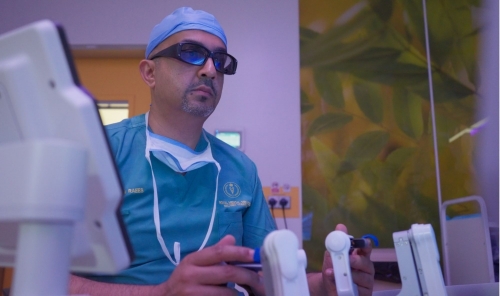
A surgeon sits at a console several metres from the operating table, guiding robotic arms with precise movements that are translated into delicate actions inside the patient’s body. What once seemed like science fiction is now becoming part of modern healthcare in Bahrain.
The Royal Medical Services (RMS) introduced the Hugo Robotic-Assisted Surgery system by Medtronic in July 2024, becoming the first hospital in the Middle East to perform surgery using the platform.
Since then, the multidisciplinary team has completed around 180 robotic procedures across urology, general surgery and gynaecology, according to Dr Ayman Aqeel Raees, Consultant Urologist, Chief of Medical Staff and Head of the Robotic Surgery Programme at RMS Bahrain.
The programme forms part of the broader vision of Major General Dr Shaikh Fahad bin Khalifa bin Salman Al Khalifa, Commander of the Royal Medical Services, to advance healthcare through the adoption of cutting-edge medical technologies, specialised equipment and continuous professional development.
Under his leadership, RMS has focused on integrating advanced technologies across its medical network, with the aim of providing citizens and residents with high-quality specialised care locally while strengthening Bahrain’s healthcare capabilities.
Dr Raees said robotic surgery represents the next stage in the evolution from conventional open surgery to minimally invasive procedures, giving surgeons greater precision, control and flexibility.
The robotic system does not replace the surgeon. Instead, surgeons control the robotic arms from a specialised console, while the technology helps eliminate natural hand tremors and enables more precise movements during complex procedures.
For patients, the benefits can include smaller incisions, less pain, reduced blood loss and faster recovery.
Dr Raees said patients undergoing procedures such as radical nephrectomy can often leave hospital within one or two days, compared with five to seven days following traditional surgery.
He also highlighted reduced blood loss during robotic radical prostatectomy procedures, noting that the programme had not required a blood transfusion following a robotic radical prostatectomy as it approached its second year.
The programme has also enabled patients to receive specialised procedures in Bahrain that previously required travel abroad.
Building the service involved extensive training, including simulator sessions, international certification and support from experienced robotic surgery specialists during the initial procedures.
RMS’s technology strategy extends beyond surgical robotics, with investments in advanced orthopaedic systems, high-precision imaging and specialised diagnostic technologies.
For Dr Raees, the technology is not about replacing surgeons but expanding what they can achieve — giving patients access to increasingly advanced treatment closer to home.
The Royal Medical Services (RMS) introduced the Hugo Robotic-Assisted Surgery system by Medtronic in July 2024, becoming the first hospital in the Middle East to perform surgery using the platform.
Since then, the multidisciplinary team has completed around 180 robotic procedures across urology, general surgery and gynaecology, according to Dr Ayman Aqeel Raees, Consultant Urologist, Chief of Medical Staff and Head of the Robotic Surgery Programme at RMS Bahrain.
The programme forms part of the broader vision of Major General Dr Shaikh Fahad bin Khalifa bin Salman Al Khalifa, Commander of the Royal Medical Services, to advance healthcare through the adoption of cutting-edge medical technologies, specialised equipment and continuous professional development.
Under his leadership, RMS has focused on integrating advanced technologies across its medical network, with the aim of providing citizens and residents with high-quality specialised care locally while strengthening Bahrain’s healthcare capabilities.
Dr Raees said robotic surgery represents the next stage in the evolution from conventional open surgery to minimally invasive procedures, giving surgeons greater precision, control and flexibility.
The robotic system does not replace the surgeon. Instead, surgeons control the robotic arms from a specialised console, while the technology helps eliminate natural hand tremors and enables more precise movements during complex procedures.
For patients, the benefits can include smaller incisions, less pain, reduced blood loss and faster recovery.
Dr Raees said patients undergoing procedures such as radical nephrectomy can often leave hospital within one or two days, compared with five to seven days following traditional surgery.
He also highlighted reduced blood loss during robotic radical prostatectomy procedures, noting that the programme had not required a blood transfusion following a robotic radical prostatectomy as it approached its second year.
The programme has also enabled patients to receive specialised procedures in Bahrain that previously required travel abroad.
Building the service involved extensive training, including simulator sessions, international certification and support from experienced robotic surgery specialists during the initial procedures.
RMS’s technology strategy extends beyond surgical robotics, with investments in advanced orthopaedic systems, high-precision imaging and specialised diagnostic technologies.
For Dr Raees, the technology is not about replacing surgeons but expanding what they can achieve — giving patients access to increasingly advanced treatment closer to home.
Related Posts