

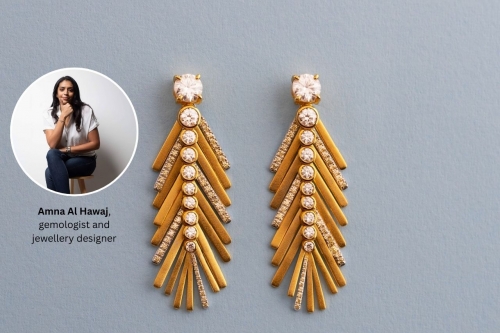
Jeweller Pairs Gulf Motifs with Lab-Grown Diamonds
Founder says ethical stones and local symbols sit behind Bahrain-made jewellery house
TDT | Manama
Email: mail@newsofbahrain.com
A decade after designing her own wedding jewellery at home in Zinj, Amna Al Hawaj has built Manjam Jewellery around Gulf-inspired design and lab-grown diamonds.
The Bahrain-based jewellery house makes diamond pieces, natural gemstone designs and work drawn from Gulf forms, colours and symbols. Al Hawaj said her ideas come from architecture, geometry, light and the visual language of the region.
‘I always try to explore the meaning of culture and the limits of culture through my designs,’ Al Hawaj told The Daily Tribune. ‘I speak about modern Gulf culture through my work.’
One design, she said, is based on the ‘serpent of eternity’. It draws on the saw-scaled viper found in the Arabian Peninsula and refers to the Epic of Gilgamesh, with a flower of immortality made from mother-of-pearl placed in the piece.
Another draws on the palm frond, a form she said still has a place in modern Gulf life.
‘The palm tree symbolises blessing, giving and strength in the desert,’ she said.
Al Hawaj has also made work based on Islamic ornament, including a sun-shaped design.
‘Through design, I try to explore how our cultures affect people and how they link to meaning. That is very important to me,’ she said.
Ethical stones
She said the American film Blood Diamond changed the way she thought about stones and helped lead her towards lab-grown diamonds.
Her first trials began about 10 years ago at her home in Zinj, where she designed jewellery for herself as an ethical choice for her wedding pieces.
‘Lab-grown stones are certainly an ethical alternative to mining, and this matters to me. It is part of the brand,’ she said. ‘They are also beautiful, and I feel people now lean towards them because they are a good choice from every side.
‘With a lab-grown diamond, you have the same quality, hardness, shine and stone traits, but it is made in a laboratory. Many people prefer this because they want to distance themselves from blood diamonds and the monopolised diamond trade.’
Manjam’s collections include diamond jewellery, rare natural gemstones and pieces shaped by Gulf heritage. Al Hawaj said the use of lab-grown diamonds was not meant to replace tradition, but to widen the choices open to clients.
Bahrain’s jewellery trade
She said Bahrain’s jewellery trade and design scene had also shaped the brand.
‘Bahrain has a remarkable jewellery tradition, and I’m fortunate to be part of it,’ she said. ‘There are many talented designers here whose work I admire, and our clients have a deep love of craft, beauty and culture.
Made to last
‘Manjam is simply my contribution to that tradition, my own reading of Gulf design through a modern lens. If our work resonates with people, I’m grateful for that.’
Al Hawaj said jewellery is often bought to mark a life event, a bond or a family memory. That view, she said, guides how Manjam works on scale, form and the long life of each piece.
Some pieces begin as sketches. Others come from talks with clients or from the look and character of a single stone.
‘The pieces we wear often become part of our lives,’ she said. ‘They celebrate milestones, mark memories and are sometimes passed from one generation to the next. Designing something that can become part of someone’s story is both a privilege and a responsibility.’
Related Posts