

Hormuz Blockade ‘Threatens World Peace’
Shipping Industry Faces Uncertainty Amid Gulf Maritime Disputes
TDT | Manama
Email: mail@newsofbahrain.com
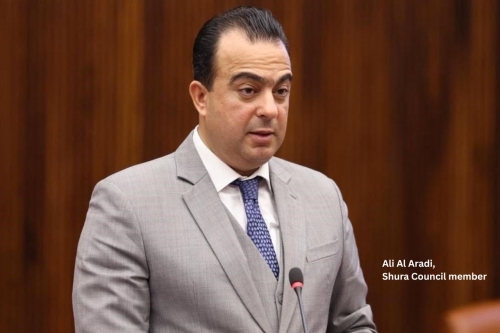
Closing or restricting the Strait of Hormuz would breach international law and strike at world peace, legal expert and Shura Council member Ali Al Aradi has warned, saying the waterway does not fall under the rule of any one state.
He said any bid to block ships, levy charges or impose selective curbs in the strait would run against the rules on transit passage under the 1982 United Nations Convention on the Law of the Sea.
Al Aradi said the issue went well beyond the Arabian Gulf, as nearly 20pc of world energy supplies pass through Hormuz, making freedom of passage there a matter for the wider world rather than the coastal states alone.
‘The Strait of Hormuz is an international waterway subject to the principle of transit passage,’ he said. ‘It is not subject to the sovereignty of any single state, and no state may obstruct or restrict navigation through it.’
He said the recent rise in tension around the strait had placed international law under a stern test, with attempts to impose a new reality in one of the world’s busiest sea lanes raising deep legal and political questions.
The core point, he added, lay in the legal standing of a strait as opposed to a canal. A strait is a natural waterway linking two larger bodies of water, such as Hormuz or Bab Al Mandab. A canal, by contrast, is a man-made route built to ease shipping.
That split shapes the law. International straits fall under the rules of the Law of the Sea Convention, which lays down the rights and duties of coastal states. Canals are mainly subject to the sovereignty of the state that built them, though their use can be curbed by treaty. He cited the Suez Canal, governed by the 1888 Convention, as an example of a man-made route whose closure or disruption is still bound by international undertakings.
Al Aradi said the Law of the Sea Convention also draws a clear line between innocent passage through a territorial sea and transit passage through an international strait. Territorial seas run 12 nautical miles from a state’s coast, where the coastal state has room to regulate passage within the law.
Transit passage is different. In straits used for international navigation, ships, aircraft and submarines have the right to pass without added conditions. He said Hormuz, about 50 kilometres wide at its narrowest point, falls under that rule.
Any demand for money from ships crossing Hormuz, or any selective curbs on passage, would be a clear breach of international law, he said. Such conduct could also be classed as economic coercion because of its direct bearing on world supply chains and energy markets.
He argued that unlawful toll-taking and the obstruction of shipping could, in some readings, also fall within the wider idea of piracy under international law.
Related Posts