

Bahrain Joins UN Women Executive Board for 2026–2028
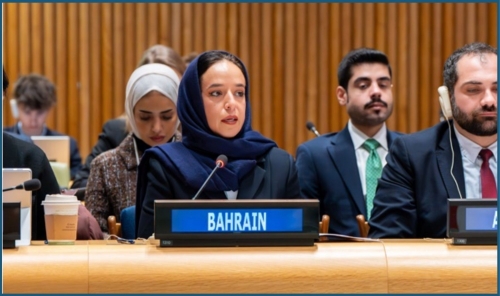
Her Highness Shaikha Hessa bint Khalifa Al Khalifa, Member of the Supreme Council for Women, participated in the first regular session of 2026 of the Executive Board of UN Women, representing the Kingdom of Bahrain.
Bahrain is serving on the Executive Board for the 2026–2028 term after securing one of the five seats allocated to the Asia-Pacific Group, following its election by the United Nations Economic and Social Council.
During her address, Shaikha Hessa conveyed the greetings of Her Royal Highness Princess Sabeeka bint Ibrahim Al Khalifa, Wife of His Majesty the King and President of the Supreme Council for Women, and expressed appreciation for the strategic role played by UN Women in strengthening alignment between national policies and international frameworks to advance women’s empowerment globally. She also voiced pride in representing Bahrain on the Executive Board for the 2026–2028 term.
Shaikha Hessa noted that Bahrain’s second membership on the Executive Board — following its previous term from 2017 to 2019 — reflects the international community’s confidence in the Kingdom’s qualitative progress and pioneering experiences in supporting women and enhancing their participation in development.
She affirmed that Bahrain will work during its membership to support the quality of UN Women’s policies and strategies related to women’s empowerment, contribute to building more inclusive societies, and help achieve the Sustainable Development Goals. She highlighted the Kingdom’s advanced levels of empowerment in technology and modern sciences.
Shaikha Hessa also underscored the importance of advancing women’s progress in the workplace, in line with Bahrain’s strategic efforts and the initiatives of the Supreme Council for Women to achieve equal opportunity values. She stressed the significance of discussions on UN Women’s strategic programmes to ensure optimal use of resources, and to enhance efficiency, transparency and accountability while delivering tangible impact.
She further emphasized the need to align UN Women’s efforts with the priorities and local needs of member states, develop monitoring and evaluation mechanisms to measure sustainability and impact — particularly in women’s economic empowerment and rights protection within development and peace contexts — and strengthen multilateral partnerships. These include cooperation with UN agencies, governments, the private sector and civil society, as well as leveraging innovation and digital solutions to improve programme implementation and reach vulnerable groups.
Shaikha Hessa concluded by reaffirming Bahrain’s commitment to continued cooperation with UN Women and to contributing to directing its programmes toward sustainable and measurable results that empower women and girls worldwide, reinforcing their role as key partners in comprehensive development.
Related Posts