

Financial safeguards
TDT | Manama
Email: mail@newsofbahrain.com
The Shura Council passed Decree-Law No. 36 of 2025 yesterday, approving changes to Bahrain’s anti-money laundering and counter-terrorist financing rules ahead of a Financial Action Task Force (FATF) assessment due in March 2026.
Members discussed the report of the Shura Council’s Foreign Affairs, Defence and National Security Committee on the decree-law, which amends parts of Decree-Law No. 4 of 2001 on the prohibition of and combating money laundering and terrorist financing.
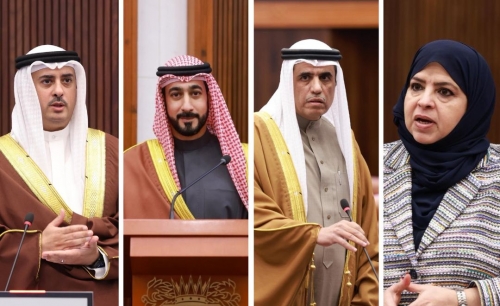
Dr Bassam Al Binmohammed, the committee’s rapporteur, said the amendments were driven by evolving methods used in money laundering, terrorist financing and the financing of the proliferation of weapons, adding that they “embody core international obligations that the Kingdom will be assessed against in the next periodic review”.
The committee report said the decree-law updates key definitions in the 2001 law, widens the forms of the money laundering offence, and tightens confiscation rules to cover proceeds and the means used, while protecting the rights of good-faith third parties.
It also replaces the schedule attached to the law to cover newly emerging activities and sectors seen as higher-risk for money laundering and terrorist financing, including virtual asset service providers.
A key change is expanded powers for the Financial Intelligence National Centre (FINC) as the implementing body, through a new Article 4 bis.
The committee said this broadens FINC’s scope in financial enquiries, analysis and coordination, including the power to request a pause or delay of suspicious transactions for a limited period while checks are completed, including in response to requests from overseas counterparts.
Crime
Dr Ali Al Rumaihi, a Shura Council member and head of the Foreign Affairs, Defence and National Security Committee, told the sitting that, “The term “money laundering” has become a media simplification; it is a crime punishable by law”, describing how its tools have changed over time and how countries now fight it through law and capable enforcement bodies.
Dalal Al Zayed, head of the Shura Council’s Legislative and Legal Affairs Committee, pointed to changes in how criminal gains are framed in the text, saying, ‘“Replacing “returns of crime” with “proceeds derived from crime” is a broader and more comprehensive definition’, capturing direct and indirect funds that can pass through property and investment.
Justice Minister, His Excellency Nawaf Al Maawda, told the council the decree-law “is important for the Kingdom of Bahrain”, linking it to Bahrain’s push to sharpen oversight tools in line with FATF standards.
Mechanisms
He said firms that provide artificial intelligence services but, within their work, manage financial portfolios, digital assets or funds through those portfolios “will be subject to accountability mechanisms”, adding that oversight follows the activity rather than simply using AI.
On cash dealings, H.E. Al Maawda cited an existing decision tied to the gold trade that bars cash payments above BD3,000, and said monitoring systems track compliance.
He added that the Central Bank of Bahrain will issue instructions spelling out the duties of banks and financial firms in applying FATF standards, and that FINC’s powers have been expanded, with the centre expected to take on a larger role in monitoring transfers.
Related Posts