

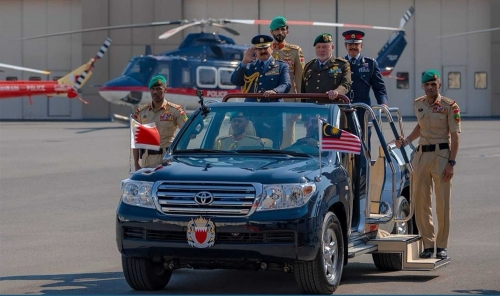
Bahrain Police Force Marches Confidently into the Future with Loyalty and Modernisation
The crime rate in Bahrain has fallen to unprecedented levels, providing the strongest on-the-ground evidence that the Kingdom’s security and stability system is becoming increasingly well established. This is due to the implementation of the security strategy launched by His Excellency Minister of Interior General Shaikh Rashid bin Abdullah Al Khalifa, which adopts community partnership as its guiding principle. During 2025, the Ministry of Interior was consistently engaged in all regional and international security cooperation. It actively took part in the joint international operation led by the International Security Alliance, targeting traffickers of narcotics and psychotropic substances. The Ministry of Interior also participated in numerous joint exercises and in the exchange of information and expertise.
This involves expanding the use of modern technologies, artificial intelligence applications, and technological innovations to combat organised crime. This presence in international security cooperation was only possible due to a security approach grounded in community partnership and the Ministry of Interior’s development and modernisation strategy, some aspects of which we present below.
Integrated series of security and community projects
Advanced security performance and efficient and accurate services have become among the most vital features of the Ministry of Interior’s work system. Consequently, several directorates received gold and platinum ratings in the fifth Government Service Centres Evaluation Programme. In this context, the Emergency Centre (999) received over 2 million calls from January to the end of last November. Operations patrols handled 27,229 cases, and 9,695 community services were provided.
In 2025, electronic reporting was launched via the “MyGov” application, enabling easy use and rapid response without the need to visit police stations.
For its part, the General Directorate of Civil Defence handled 13,838 cases up to last November. Awareness efforts and training programmes reached 511 activities. The Special Security Force also focused on improving performance across operational and training aspects. Police directorates across the governorates continued their security operations to maintain public order and improve services, handling nearly 70,000 cases from the beginning of the year to mid-October. The ongoing efforts involve equipping the Police Aviation with modern helicopters to enhance its technical capabilities and capacity for public safety, emergency medical services, and law enforcement. The Police Aviation carried out 557 flights, amounting to 392 flight hours.
The General Directorate of Criminal Investigation and Forensic Science managed numerous criminal cases. By the end of October, 1,733 drug control cases were reported.
The Anti-Narcotics Directorate ranked first in the category of best field cooperation in information and operations at the Arab level. Meanwhile, the number of human trafficking cases this year reached 39, and Bahrain retained its Tier 1 status in fighting human trafficking for the eighth consecutive year, according to the US Department of State’s report. The Coast Guard strengthened maritime security and safety through an integrated fleet of modern vessels equipped with the latest technology to support maritime control and surveillance.
The Coast Guard launched 617 search-andrescue operations, responded to accidents and distress calls, and tackled 787 maritime violators, while the number of inspection and awareness campaigns reached 34. In combating economic crimes, the number of reports handled from the beginning of the year through the end of November reached 4,286. The Anti-Cyber Crimes Directorate received 1,661 cases.
The Anti-Corruption Directorate handled 193 cases as of the beginning of this month. The Child Protection Unit in Cyberspace handled 326 cases this year. The National Ambulance Centre received 55,388 cases by the end of last November. It earned accreditation for excellence from the International Academies of Emergency Dispatch. The Alternative Sentencing Project reflects the humanitarian values embedded in HM the King’s vision.
As of the beginning of December 2025, approximately 10,170 individuals have benefited from alternative sentencing since the law’s implementation in May 2018. This year, a series of events and programmes was organised to reinforce the programme’s objectives. Meanwhile, the “Fael Khair” initiative supported approximately 817 people, with a total value of BD3,620,000.
In the same context, the General Directorate of Reformation and Rehabilitation has adopted a comprehensive set of rehabilitation programmes, underscoring its commitment to strengthening the national approach to upholding human rights.
Related Posts