

Bundibugyo Virus Outbreak in DRC and Uganda Rises to 952 Cases
The Bundibugyo virus disease outbreak in the Democratic Republic of Congo (DRC) and Uganda has continued to escalate, reaching 952 confirmed cases and 247 deaths as of June 18, 2026, according to the latest briefing from the Africa Centres for Disease Control and Prevention. The overall case fatality rate now stands at 25.9%.
The outbreak remains heavily concentrated in the Democratic Republic of the Congo, which accounts for 933 cases and 245 deaths, while Uganda has reported 19 confirmed cases and two deaths, with limited evidence of sustained community transmission compared to its neighbour.
Ituri Province Remains Epicentre
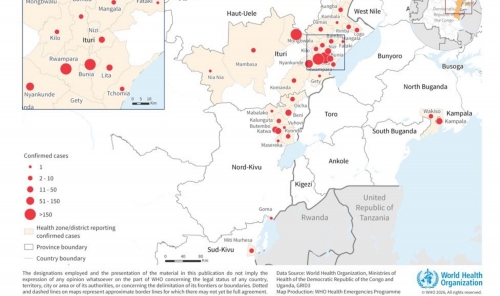
In the DRC, Ituri Province continues to be the epicentre, responsible for roughly 91% of all confirmed infections. Major hotspots include Bunia, Rwampara, and Mongbwalu.
Health officials also flagged North Kivu Province as a major concern due to its extremely high case fatality rate of 58.4%, with severe outcomes reported across multiple health zones.
Overall, the outbreak has now spread across 34 health zones in the DRC and one district in Uganda, with cases also reported in Uganda’s capital Kampala, including both imported and locally acquired infections.
New Cases and Data Adjustments
During the most recent reporting period, 36 new cases and 12 deaths were confirmed. Additional data reconciliation added one case and 25 deaths from earlier reporting periods, highlighting ongoing challenges in surveillance and reporting accuracy.
Response Efforts Intensify Amid Pressure on Health Systems
Response teams are continuing to scale up efforts in surveillance, laboratory testing, case management, infection prevention and control, and risk communication.
A new laboratory in Aru, Ituri, has become operational, increasing the total number of testing sites to six.
However, authorities report significant strain on the health system. Treatment centres are operating above capacity, with bed occupancy at 102% and at least 349 patients currently admitted across affected areas.
Logistical constraints — including ambulance shortages, delayed referrals, gaps in protective equipment, and restricted access to remote or insecure regions — are hindering response operations.
Surveillance and Community Challenges Persist
More than 7,200 contacts have been identified across both countries. However, surveillance and contact tracing efforts continue to face difficulties due to incomplete patient data, delayed investigations, and access limitations in some communities.
Community engagement remains central to containment efforts, with health teams working alongside religious leaders, local authorities, and frontline workers to improve trust and encourage early reporting.
Resistance to certain public health measures, including decontamination, isolation, and post-mortem sampling, continues to be reported in some areas.
Border Measures and Regional Coordination
Approximately 80% of points of control are operational, screening nearly 95% of travellers.
Uganda has also introduced a temporary four-week closure of its border for non-essential travel as part of broader containment measures.
The Africa Centres for Disease Control and Prevention and partners are supporting both countries through rapid response teams, laboratory strengthening, infection control measures, and cross-border coordination.
Funding Gap Identified
An urgent funding requirement of US$21.5 million has been identified to support critical gaps across surveillance, logistics, case management, and community engagement efforts.
Related Posts