

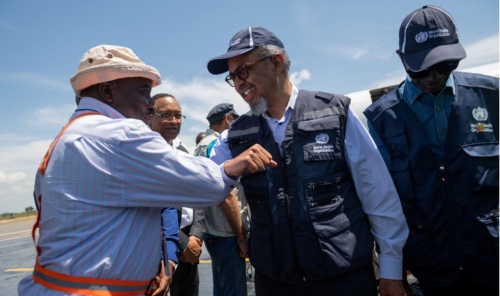
WHO chief in Bunia: “We will see this through together”
- Tedros Adhanom Ghebreyesus visits Ituri province, calling for stronger funding, trust-building, and global cooperation
- Over 1,000 suspected cases reported as outbreak spreads into Uganda and multiple Congolese provinces
- Health systems strained amid insecurity, misinformation, and limited laboratory capacity
- WHO says promising vaccine candidates moving toward clinical trials
The head of the World Health Organization (WHO), Tedros Adhanom Ghebreyesus, has called for increased international assistance to contain a fast-moving Ebola outbreak in eastern Democratic Republic of the Congo, as he visited the hardest-hit region of Ituri province on Saturday.
Speaking in Bunia, the provincial capital, Tedros said global partners were already supporting the Congolese authorities but stressed that more resources, stronger community engagement, and better trust-building were urgently needed to slow the spread of the virus.
“We are here to discuss with the community, to see how the response is running and if there are challenges to help,” he said, adding later: “You’re not alone in this. We’re here, we’re with you, and we will see this through together.”
He emphasized that tackling misinformation and mistrust within affected communities was as important as medical intervention, describing “community ownership” as a key factor in controlling the outbreak.
The Ebola virus has now spread across at least three provinces in eastern DRC and into neighbouring Uganda, raising regional alarm. According to the Africa Centres for Disease Control and Prevention, there have been at least 1,077 suspected cases and 246 deaths in the DRC since the outbreak was declared on May 15. Uganda has also reported nine confirmed infections, including one death.
Health authorities warn that the actual scale of the outbreak may be significantly larger, as surveillance and laboratory testing capacity remain limited in remote and conflict-affected areas.
The region, particularly Ituri province, has long been affected by armed group activity, which continues to restrict access for health workers and humanitarian agencies, complicating response efforts.
Medical charity Médecins Sans Frontières (MSF) warned earlier that the outbreak has escalated unusually quickly, noting that the number of cases recorded in the initial phase is among the highest ever seen for Ebola outbreaks in the country. The organisation also highlighted a shortage of trained medical personnel deployed to affected areas.
In response to regional spread, Uganda has closed its border with the DRC and introduced a 21-day quarantine for arrivals from the neighbouring country.
Despite the escalating situation, WHO officials reported a small milestone this week: a patient infected with Ebola has recovered after testing negative twice and has been discharged from care, marking the first known recovery in the current outbreak.
Ebola, a highly infectious haemorrhagic fever transmitted through direct contact with bodily fluids, has killed more than 15,000 people across Africa over the past five decades. The most severe outbreak in the DRC between 2018 and 2020 resulted in nearly 2,300 deaths.
Health experts are now focusing on vaccine development and deployment. While no approved vaccine currently exists for the Bundibugyo strain driving the outbreak, Africa CDC officials say a candidate vaccine could be ready by the end of the year. WHO also confirmed that several potential vaccines are being assessed for clinical trials due to promising early results.
Tedros said the situation remains containable if coordinated action continues: “If we do our best, it can be stopped,” he said, stressing that success depends on cooperation between local communities, national authorities, and international partners.
Related Posts