

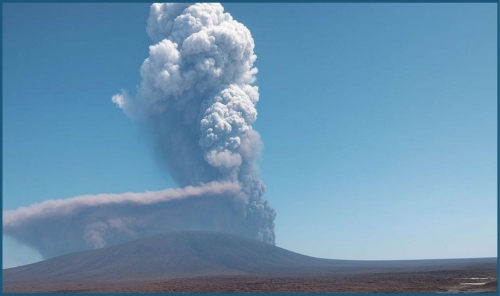
Ethiopia’s Hayli Gubbi Volcano Erupts After 12,000 Years of Silence
Ash plumes reach 14km high, drift across Red Sea toward Yemen and Oman; local communities brace for economic impact
A long-dormant volcano in Ethiopia’s north-eastern Afar region has erupted for the first time in nearly 12,000 years, sending massive plumes of ash up to 9 miles (14km) into the sky and across the Red Sea toward Yemen and Oman.
The Hayli Gubbi volcano, situated about 500 miles north-east of Addis Ababa near the Eritrean border, erupted for several hours on Sunday. Local officials confirmed that no casualties have been reported so far.
Mohammed Seid, a regional official, said the eruption poses significant economic risks for Afar’s pastoral communities.
“While no human lives and livestock have been lost so far, many villages have been covered in ash and as a result their animals have little to eat,” he said, noting that there is no previous record of any eruption from Hayli Gubbi.
Standing roughly 500 metres high, the volcano lies within the geologically active Rift Valley, where two tectonic plates meet. The Volcanic Ash Advisory Centre (VAAC) reported that ash clouds drifted over Yemen, Oman, India, and northern Pakistan.
Residents described hearing a strong blast as the eruption began. Ahmed Abdela, who lives nearby, said it felt like “a sudden bomb” accompanied by a shock wave, smoke, and ash.
Satellite images showed a thick plume rising from the volcano, although videos circulating on social media could not immediately be verified.
According to the Smithsonian Institution’s Global Volcanism Program, Hayli Gubbi has had no known eruptions during the Holocene period, which began roughly 12,000 years ago. Volcanologist Simon Carn of Michigan Technological University also confirmed the lack of historical eruption records.
Related Posts