

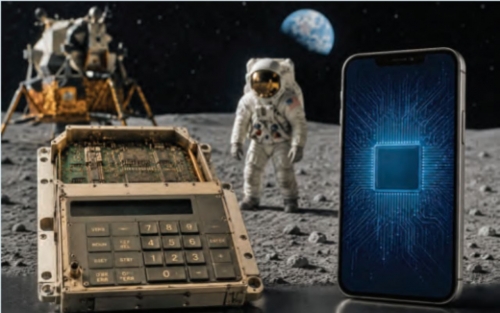
The Computer That Took Humans to the Moon Was Less Powerful Than Your Smartphone
TDT | Manama
Email: mail@newsofbahrain.com
When NASA’s Apollo 11 mission landed astronauts on the Moon in 1969, the onboard Apollo Guidance Computer (AGC) had just 64 KB of memory and operated at a speed of 1.024 MHz. By comparison, even an entry-level smartphone today has millions of times more processing power and several gigabytes of memory.
Despite its modest specifications, the AGC was one of the most advanced computers of its time. It guided the spacecraft through space, calculated the landing trajectory and helped astronauts safely touch down on the lunar surface. During the final descent, the computer even prioritised critical tasks when overloaded, allowing the mission to continue successfully.
The Apollo Guidance Computer proved that innovative software and efficient engineering can achieve extraordinary results—even with limited hardware. Today, it remains one of the greatest milestones in the history of computing and space exploration.
Related Posts