

IISS Manama Dialogue to begin today
The Manama Dialogue, a major international security conference, will be held here from October 30 to November 1. The latest developments in the region, particularly Iran’s nuclear programme and the fight against terrorism, are expected to be among the top issues to be discussed at the annual gathering.
“The Middle East is going through a period of extraordinary strategic unease,” Dr John Chipman, Director-General and CEO of the International Institute for Strategic Studies (IISS), the co-organisers alongside Bahrain’s Ministry of Foreign Affairs, said.
The Manama Dialogue 2015 will offer a unique opportunity for foreign and Defense Ministers from the Middle East and outside to confer on the implementation of the E3 plus 3 nuclear agreement with Iran. “The IISS expects new policy initiatives to be tested and launched at the Manama Dialogue, which will again attract both leading policymakers from around the world and the best strategic analysts on the region,” he said.
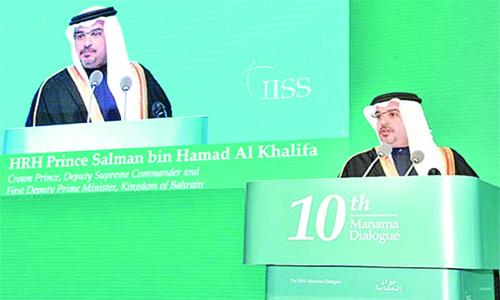
National security leaders from the Gulf, the Middle East, North America, Europe and Asia will attend the 11the edition of the IISS Manama Dialogue. In the 10th Manama Dialogue last year, Crown Prince, Deputy Supreme Commander and First Deputy Premier HRH Prince Salman bin Hamad Al Khalifa said the international community was fighting not only terrorists, but also theocrats.
Prince Salman said, “Terrorism is merely the tool that is used by people. If I think back in the last century, we faced a very different foe; we faced communism and we faced it together. But when we faced communism, we understood it as an ideology. Terrorism is not an ideology.” Commenting on the terrorists, he said: “These are people who isolate themselves from the rest of the international community.
These are people who disregard human life and do not value the social order. These are people who oppress women, and these are people who slaughter anyone who does not condone, approve of or subscribe to their own twisted ideology.” “While politics may drag people into ideology, it is the ideology itself that must be combated. It must be named, it must be shamed, and it must be contained.
Eventually, it must be defeated, and we must use all resources to hold accountable those who place themselves above other ordinary human beings and claim they have a divine right to rule,” HRH the Crown Prince added.
Report by DT News Network
Yemen issue to take centre stage in discussions
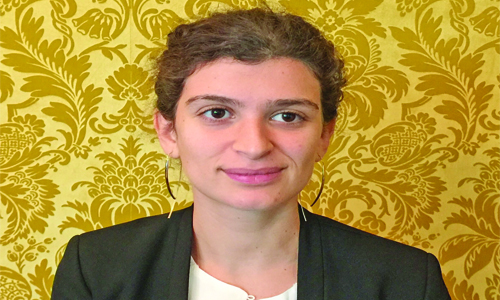
The crisis in Yemen will figure high on the agenda of the 11th International Institute for Strategic Studies (IISS) Manama Dialogue, said Hebatalla Taha, the research analyst of IISS-Middle East.
“In a special session entitled “The Future of Yemen,” the Manama Dialogue hopes to stimulate critical debate and reflection over the rapidly deteriorating situation and some of the paradoxes it
has produced,” the research analyst said. She explained: “Having pulled out of earlier UN-mediated talks, the Hadi government has been renewing attempts to gain a decisive edge on the battlefield. Last month, forces from the Saudi-led coalition launched a major push towards Sana’a through the central province of Ma’rib. Despite few tangible results, the coalition announced in mid-October that it would open a new front against the Huthis in Al Jawf province, north of Ma’rib.” “Meanwhile, the Huthis, allying with fighters loyal to former president Saleh, have been making gains in the central provinces of Al Bayda and Ta’izz. This also risks a further prolongation of the conflict,” Taha said.
“Over the past seven months, more than 5,500 people have been killed in this war with no real winners. The Huthis have recently been besieging thousands of civilians in Ta’izz, who have also been repeatedly subject to indiscriminate shelling. Activists and journalists who attempted to break the siege on 14 October were detained, while food and medicine have reportedly been confiscated from civilians,” she explained.
Meanwhile, Taha said that Al-Qaeda-affiliated groups, alongside some ISIS-linked groups, in southern Yemen had been spreading their wings, adding fuel to the hostility. “Reconciliation will also be contingent upon an immediate acknowledgment of the pervasive insecurity and economic hardship that the war has created,” she added.
Deputy Prime Ministers, Foreign, Defence and Interior Ministers, national security advisers and senior military officers – from all around the region- are expected to participate in the three-day event.
Related Posts