

Plan to Track Bahrain’s Old Trees
TDT | Manama
Email: mail@newsofbahrain.com
An ambitious plan to number, log and track Bahrain’s mature and rare trees has been put forward to stop them from being needlessly cut down or lost to housing and development schemes.
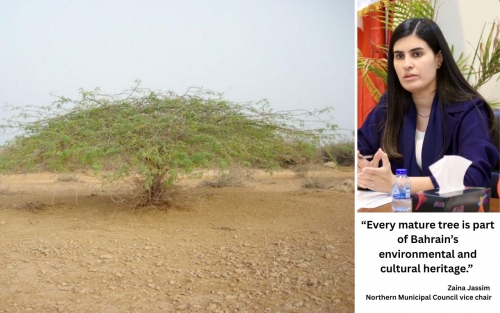
Northern Municipal Council vice chair Zaina Jassim wants a legal and administrative system to record the trees, track their condition and govern any move or removal.
Her proposal also calls for a specialist committee to assess trees and decide their fate.
‘Mature and rare trees carry great environmental, social and historical value,’ Ms Jassim told The Daily Tribune. ‘They also have a strong link to the memory of successive generations, which calls for an integrated framework to protect and document them.’
Each tree would receive its own number and record, including details like species, size, age and location.
Ms Jassim said the system would make it easier to move trees where needed, particularly on sites earmarked for housing or other development, while protecting those of environmental or heritage value.
‘Numbering and documenting the trees will give us a full statistical database of their numbers, types, sizes, ages and locations,’ she said.
The records could then be used for regular counts, checks on tree health and necessary maintenance.
Bahrain is home to trees with strong environmental or heritage value, including ghaf, sidr, tamarisk and grey mangrove. The best-known example is the centuries-old Tree of Life in Sakhir, while mangroves are an important part of the kingdom’s coastal habitat.
Ms Jassim also called for an electronic system covering trees across Bahrain, giving authorities a clear record before any tree is cut down or moved.
She said such a system would provide greater control over those decisions and allow the data to feed into future environmental and development plans.
The proposal follows an earlier move by Ms Jassim to encourage tree planting outside new homes and buildings.
That plan called for a voluntary planting condition to be added to building permits of different kinds.
Owners would be encouraged to plant outside their property boundary where space allows, provided trees do not encroach on road reserves, neighbouring land or pose a risk to traffic.
The measure was aimed at putting more trees around homes and buildings, improving streets, cutting pollution and giving wildlife greater room to thrive.
Related Posts