

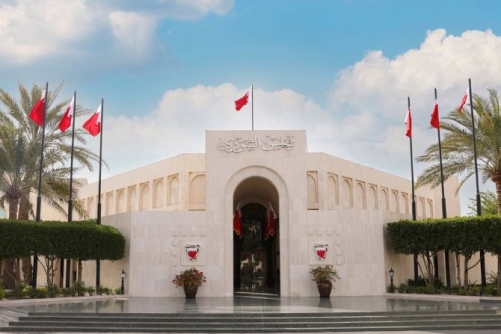
Shura to discuss private education law and proposed cybercrime amendment
TDT | Manama
Email: mail@newsofbahrain.com
The Shura Council will discuss, at its twentieth session in the fourth session of the sixth legislative term, to be held today, the first supplementary report of the Services Committee on a draft law amending certain provisions of Decree-Law No. (25) of 1998 concerning private educational and training institutions.
The draft law, submitted by the Council of Representatives, includes a recommendation from the committee not to approve it in principle.
According to the memorandum of the Legislation and Legal Opinion Authority, the draft law aims to give priority to employing qualified Bahraini nationals in educational positions within the private sector.
Review
The committee explained in its report that during its review of the draft law, Law No. (4) of 2026 on private educational institutions was issued on January 28, 2026.
Article Five of the issuance articles states that all provisions related to private educational institutions in Decree-Law No. (25) of 1998 are repealed, along with any text that contradicts the new law.
The committee noted that, in light of this legislative development, the objective of the draft law relates to provisions that are no longer in force regarding private educational institutions.
As for private training institutions, data provided by the Ministry of Labour showed that the Bahrainization rate among licensed trainers reached 93.12% in 2024, while the overall Bahrainization rate for licensed trainers stood at 74%.
This indicates that the intended goal of the draft law has already been achieved in practice through existing policies and regulations.
The Council will also discuss the report of the Foreign Affairs, Defence and National Security Committee on a proposal to add a new Article (10 bis) to Law No. (60) of 2014 on Cybercrime.
The proposal was submitted by members Ali Hussein Al Shihabi, Jamal Mohammed Fakhro, Dr. Mohammed Ali Hassan Ali, Khalid Hussein Al Maskati and Dalal Jassim Al Zayed.
The committee recommended rejecting the proposal.
Memorandum
According to its explanatory memorandum, the proposal seeks to criminalize the use of information technology systems to produce, alter, circulate, distribute, publish or make available audio or visual content that could subject others to contempt or punishment, harm family reputation, or be committed for an unlawful purpose.
The committee stated that existing criminal provisions already provide sufficient protection against the misuse of deepfake technologies, making a new specific criminal article unnecessary.
Deepfake refers to the use of artificial intelligence and machine learning technologies to create or modify digital audio or visual content in a way that falsely represents real persons or events and is difficult to distinguish from reality.
Related Posts