

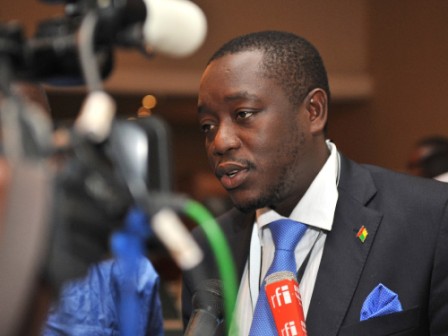
President of crisis-hit Guinea-Bissau appoints new PM
Bissau
Guinea-Bissau's president appointed the ruling party's deputy leader Carlos Correia as the new prime minister on Thursday to try to turn the page on a month-long political crisis.
Correia, 81, a veteran of the former Portuguese colony's struggle for independence who has already headed the government three times, was named in a decree read out on state radio.
The coup-plagued west African nation has been in turmoil since President Jose Mario Vaz fired prime minister Domingos Simoes Pereira on August 12 over a series of disputes including the naming of a new army chief.
Pereira's sacking put the head of state at loggerheads with his ruling African Party for the Independence of Guinea and Cape Verde (PAIGC), which denounced the move as a "constitutional coup".
Pereira announced Correia's nomination to reporters late on Wednesday after Vaz had announced he was allowing the PAIGC the right to propose a compromise candidate for the premiership.
Correia, the party's principal vice-president, is the country's third prime minister in a little over a month.
An East German-trained agricultural engineer, he has earned a reputation as a rigorous money man, garnering praise from international groups including the IMF and the World Bank for his stewardship in times of crisis.
He served previously as head of the government December 1991 to October 1994, from June 1997 to December 1998 and again from August until December 2008.
Instability in Guinea-Bissau, which gained independence from Portugal in 1974 after a war with its colonial power lasting more than ten years, is nothing new.
The country has suffered intermittent unrest since its liberation, as well as a series of military coups attributed largely to the unprecedented bloating of the army after the war.
The chronic volatility has fanned poverty in the country of 1.6 million, with few resources other than cashew nuts and fish, attracting South American drug cartels who turned it into a hub of cocaine trafficking for west Africa.
- Dockers' massacre -
Born in Bissau, Correia is recognised among "historic" campaigners of the liberation struggle against Portugal, and has seen as much political upheaval as any politician in the country.
Correia was present as the dockers' massacre at the Pijiguiti port in Bissau on August 3, 1959, when the colonial power's police opened fire on the striking workers, killing more than 50 people.
He was finance minister in the administration of Francisco Mendes, the country's first prime minister who was assassinated in 1978.
A member of PAIGC Politburo in the 1980s and responsible for agriculture and fisheries, Correia was elevated to head of government when the office was reopened after having been abolished in 1984.
He served under president Joao Bernardo Vieira for three years until 1994, when he was succeeded by Manuel Saturnino da Costa after the PAIGC won the first multiparty presidential and parliamentary elections.
Correia has personal experience of both sides of the current crisis, having previously been in much the same position as Dja, who was forced to resign last week.
The new premier's second term in 1997 lasted just a few months after the Supreme Court ruled that his appointment was unconstitutional, because parliament had not been consulted.
He was eventually confirmed but the term was overshadowed by the rebellion of Ansumane Mane, who started a brief civil war in 1998 after being dismissed as army chief.
Correia and 14 other supporters of Vieira were arrested after the head of state was overthrown in 1999 and they were charged with inciting warfare and providing financial support to their deposed president.
Correia spent a short time in jail and was expelled from the PAIGC in September 1999, along with Vieira and five other former ministers.
He was arrested again in 2000 along with several other former ministers over a corruption scandal involving government bonds but acquitted of embezzlement three years later.
He was allowed to rejoin his party but found himself arrested again along with other PAIGC members for the execution of five people after a failed coup in 1986. He was released after four days.
Related Posts